


Page 60 - ESAM-1-1
P. 60
Engineering Science in
            Additive Manufacturing                                                Additive manufacturing of EH36 steels


            Table 5. Comparison between state‑of‑the‑art AM techniques for the fabrication of EH36 steel
            AM              Critical characteristics         Advantages                      Limitations
            PBF-LB        High precision, small melt   Produces complex geometries with excellent   High residual stresses; small
                          pools, fine microstructure  surface finish and dimensional accuracy;   build volume; stringent powder
                                                   refined microstructures           requirements
            DED-LB        Moderate precision, large   Efficient for medium-to-large components;   Moderate residual stresses; coarser
                          melt pools, versatile feedstock   flexible feedstock usage; high deposition   microstructures
                          options                  efficiency
            DED-Arc       Low precision, very large   Highly scalable; cost-effective for large   Low surface quality; significant
                          melt pools, continuous wire   structures; rapid production rates  anisotropy; requires careful thermal
                          feedstock                                                  management
            Abbreviations: AM: Additive manufacturing; DED-Arc: Direct energy deposition using electric arc; DED-LB: Direct energy deposition using laser
            beam; PBF-LB: Powder bed fusion using laser beam.


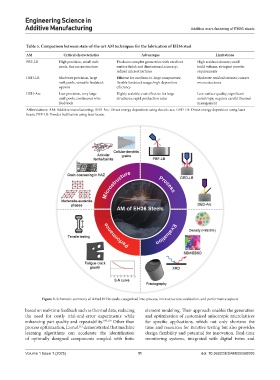
                   Figure 2. Schematic summary of AMed EH36 steels, categorized into process, microstructure, evaluation, and performance aspects

            based on real-time feedback such as thermal data, reducing   element modeling. Their approach enables the generation
            the need for costly trial-and-error experiments while   and optimization of customized anisotropic microlattices
            enhancing part quality and repeatability. 109,110  Other than   for specific applications, which not only shortens the
            process optimization, Li et al.  demonstrated that machine   time and resources for iterative testing but also provides
                                   111
            learning  algorithms  can  accelerate  the  identification   design flexibility and potential for innovation. Real-time
            of  optimally  designed  components coupled with finite   monitoring systems,  integrated  with digital  twins and


            Volume 1 Issue 1 (2025)                         11                         doi: 10.36922/ESAM025060005

