


Page 38 - GHES-1-1
P. 38
Global Health Econ Sustain                                      Neuroinclusive workplaces and biophilic design


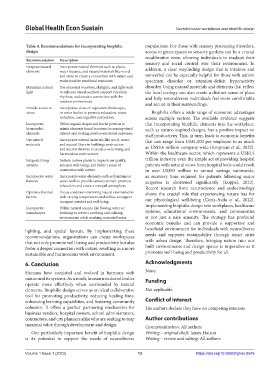
            Table 4. Recommendations for incorporating biophilic   populations. For those with sensory processing disorders,
            design                                             access to green spaces or sensory gardens can be a crucial
                                                               recalibration zone, allowing individuals to  readjust their
            Recommendation  Description                        sensory and social control over their  environment. In
            Integrate natural   Incorporate natural elements such as plants,   addition, a clear wayfinding design that is intuitive and
            elements      water features, and natural materials like wood
                          and stone to create a connection with nature and   nonverbal can be especially helpful for those with autism
                          evoke positive emotional responses.  spectrum disorder or attention-deficit hyperactivity
            Maximize natural   Use abundant windows, skylights, and light wells   disorder. Using natural materials and elements that reflect
            light         to enhance visual comfort, support circadian   the local ecology can also create a distinct sense of place
                          rhythms, and create a connection with the   and help neurodiverse individuals feel more comfortable
                          outdoor environment.                 and secure in their surroundings.
            Provide access to   Incorporate views of vegetation, landscapes,
            views         or water bodies to promote relaxation, stress   Biophilia offers a wide range of economic advantages
                          reduction, and cognitive restoration.  across multiple sectors. The available evidence suggests
            Incorporate   Utilize organic shapes and fractal patterns to   that incorporating biophilic elements into the workplace,
            biomorphic    mimic elements found in nature, increasing visual   such as nature-inspired designs, has a positive impact on
            elements      interest and evoking positive emotional responses.
                                                               staff productivity. This, in turn, leads to economic benefits
            Use natural   Incorporate natural materials like wood, stone,   that can range from US$1,000 per employee to as much
            materials     and natural fibers in building construction   as US$3.6 million company-wide (Kropman et al., 2022).
                          and interior finishes to create a welcoming and
                          harmonious environment.              Within the healthcare sector, which represents a US$2.5
            Integrate living   Include indoor plants to improve air quality,   trillion industry, even the simple act of providing hospital
            systems       enhance well-being, and foster a sense of   patients with natural views from hospital beds could result
                          connection with nature.              in over US$93 million in annual savings nationwide,
            Incorporate water   Incorporate water elements such as fountains or   as recovery time required for patients following major
            features      water walls to provide sensory stimuli, promote   surgeries is shortened significantly (Koppel, 2022).
                          relaxation, and create a tranquil atmosphere.  Recent research from neuroscience and endocrinology
            Optimize thermal   Create conditions mirroring natural environments   shows the crucial role that experiencing nature has for
            factors       with varying temperatures and airflow to support
                          occupant comfort and well-being.     our  physiological  well-being  (Coria-Avila  et al.,  2022).
            Incorporate   Utilize natural sounds like flowing water or   Implementing biophilic design into workplaces, healthcare
            soundscapes   birdsong to create a soothing and calming   systems, educational environments, and communities
                          environment while masking unwanted noise.  is not just a nice amenity. The strategy has profound
                                                               economic benefits and can provide a supportive and

            lighting, and spatial layouts. By implementing these   beneficial environment for individuals with neurodiverse
            recommendations, organizations can  create workspaces   needs  and supports sustainability through smart cities
            that not only promote well-being and productivity but also   with urban design. Therefore, bringing nature into our
            foster a deeper connection with nature, resulting in a more   built environments and design spaces is imperative as it
            sustainable and harmonious work environment.       promotes well-being and productivity for all.
            6. Conclusion                                      Acknowledgments

            Humans have coexisted and evolved in harmony with   None.
            nature and its systems. As a result, human minds and bodies   Funding
            operate more effectively when surrounded by natural
            elements. Biophilic design serves as an ideal collaborative   Not applicable.
            tool for promoting productivity, reducing healing time,
            enhancing learning capabilities, and fostering community   Conflict of interest
            cohesion. It offers a perfect partnering mechanism for   The authors declare they have no competing interests.
            business vendors, hospital owners, school administrators,
            contractors, and city planners alike who are seeking to reap   Author contributions
            maximal value through development and design.      Conceptualization: All authors

              One particularly important benefit of biophilic design   Writing – original draft: James Hutson
            is its potential to support the needs of neurodiverse   Writing – review and editing: All authors


            Volume 1 Issue 1 (2023)                         13                       https://doi.org/10.36922/ghes.0549

