


Page 34 - GHES-1-1
P. 34
Global Health Econ Sustain                                      Neuroinclusive workplaces and biophilic design


              In addition to the PenPlace development in Arlington,   surrounding air  temperature  and  leading to  increased
            Amazon has undertaken other innovative projects, such as   energy efficiency and lower air conditioning costs.
            the futuristic biospheres in Seattle (Bishop, 2016). These   Moreover, the wall serves as a sound barrier, enhancing
            spheres resemble parks more than offices, featuring over   the office’s acoustics and providing a more comfortable
            3,000 plants from 30 countries, tree-house meeting rooms,   working  environment.  The  breathing  wall  comprises
            water features, a birdcage-themed conference room,   modules made from linear, low-density polyethylene,
            environmental fogging, and a five-story living wall. These   which can be infinitely recycled. The modules are filled
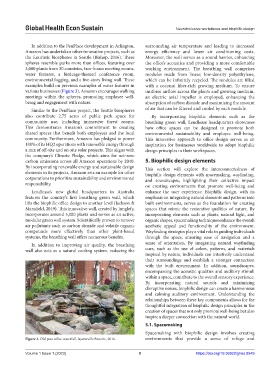
            examples build on previous examples of water features in   with a coconut fiber-rich growing medium. To ensure
            various businesses (Figure 3). Amazon encourages walking   uniform airflow across the plants and growing medium,
            meetings within the spheres, promoting employee well-  an electric axial impeller is employed, enhancing the
            being and engagement with nature.                  absorption of carbon dioxide and maximizing the amount
              Similar to the PenPlace project, the Seattle biospheres   of air that can be filtered and cooled by each module.
            also contribute 2.75 acres of public park space for   By incorporating biophilic elements such as the
            community use, including immersive forest rooms.   breathing green wall, Lendlease headquarters showcases
            This demonstrates Amazon’s commitment to creating   how office spaces can be designed to promote both
            shared spaces that benefit both employees and the local   environmental sustainability and employee well-being.
            community. Furthermore, Amazon has pledged to power   This innovative approach to office design serves as an
            100% of its HQ2 operations with renewable energy through   inspiration for businesses worldwide to adopt biophilic
            a mix of off-site and on-site solar projects. This aligns with   design principles in their workspaces.
            the  company’s  Climate  Pledge,  which  aims  for  net-zero
            carbon emissions across all Amazon operations by 2040.   5. Biophilic design elements
            By incorporating renewable energy and sustainable design   This section will explore the interconnectedness of
            elements in its projects, Amazon sets an example for other   biophilic design elements with spacemaking, wayfinding,
            corporations to prioritize sustainability and environmental   and soundscapes, highlighting their collective impact
            responsibility.                                    on creating environments that promote well-being and
              Lendlease’s new global headquarters in Australia   enhance the user experience. Biophilic design, with its
            features the country’s first breathing green wall, which   emphasis on integrating natural elements and patterns into
            lifts the biophilic office design to another level (Jackson &   built environments, serves as the foundation for creating
            Mansfield, 2019). This innovative wall, created by Junglefy,   spaces that mimic the restorative qualities of nature. By
            incorporates around 5,000 plants and serves as an active,   incorporating elements such as plants, natural light, and
            modular green wall system. Scientifically proven to remove   organic shapes, spacemaking techniques enhance the overall
            air pollutants such as carbon dioxide and volatile organic   aesthetic appeal and functionality of the environment.
            compounds  more  effectively  than  other  plant-based   Wayfinding strategies play a vital role in guiding individuals
            systems, the breathing wall offers numerous benefits.  through the space, ensuring ease of navigation and a
              In addition to improving air quality, the breathing   sense  of orientation.  By integrating natural  wayfinding
            wall also acts as a natural cooling system, reducing the   cues, such as the use of colors, patterns, and materials
                                                               inspired by nature, individuals can intuitively understand
                                                               their surroundings and establish a stronger connection
                                                               with the built environment. In addition, soundscapes,
                                                               encompassing the acoustic qualities and auditory stimuli
                                                               within a space, contribute to the overall sensory experience.
                                                               By incorporating natural sounds and minimizing
                                                               disruptive noises, biophilic design can create a harmonious
                                                               and calming auditory environment. Understanding the
                                                               relationships between these key components allows for the
                                                               thoughtful integration of biophilic design principles in the
                                                               creation of spaces that not only promote well-being but also
                                                               inspire a deeper connection with the natural world.

                                                               5.1. Spacemaking
                                                               Spacemaking with biophilic design involves creating
            Figure 3. Old post office waterfall, fayetteville historic, 2016.  environments that provide a sense of refuge and


            Volume 1 Issue 1 (2023)                         9                        https://doi.org/10.36922/ghes.0549

