


Page 30 - GHES-1-1
P. 30
Global Health Econ Sustain                                      Neuroinclusive workplaces and biophilic design


              The concept of biophilic design continued in the fin de
            siècle and from modernist trends in art and architecture,
            such as Art Nouveau, which aimed to reconnect individuals
            with the natural world (Grady, 1955; Joye, 2011). Since then,
            research has confirmed that by incorporating elements
            such as water, light, and plants, as well as emphasizing
            botanical forms and curvilinear shapes, biophilic design
            principles are able to create an immersive and multisensory
            environment that enhances human health and well-
            being (Gierbienis, 2019; Gillis & Gatersleben, 2015). In
            fact, the impact of biophilic design on various aspects of
            human health and performance, including life expectancy,
            productivity, mental health, absenteeism, and eye fatigue,
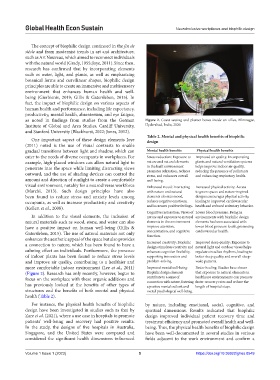
            as noted in findings from studies from the German   Figure 2. Guest seating and planter boxes inside an office, Filmnagar,
            Institute of Global and Area Studies, Cardiff University,   Hyderabad, India, 2020.
            and Stanford University (Blackhurst, 2022; Jones, 2012).
                                                               Table 2. Mental and physical health benefits of biophilic
              One important aspect of these design elements Joye   design
            (2011) noted is the use of visual contrasts to enable
            gradual transitions between light and shadow, which can   Mental health benefits  Physical health benefits
            cater to the needs of diverse occupants in workplaces. For   Stress reduction: Exposure to   Improved air quality: Incorporating
            example, high-placed windows can allow natural light to   nature and natural elements   plants and natural ventilation systems
            penetrate into the space while limiting distracting views   in the built environment   helps improve indoor air quality,
                                                               promotes relaxation, reduces
                                                                                    reducing the presence of pollutants
            outward, and the use of shading devices can control the   stress, and enhances overall   and enhancing respiratory health.
            amount and direction of sunlight to create a comfortable   well-being.
            visual environment, notably for a neurodiverse workforce   Enhanced mood: Interacting   Increased physical activity: Access
            (Marchi, 2013). Such design principles have also   with nature and natural   to green spaces and nature-inspired
            been found to reduce stress and anxiety levels among   elements elevates mood,   designs encourages physical activity,
            occupants, as well as increase productivity and creativity   reduces negative emotions,   leading to improved cardiovascular
            (Kellert et al., 2008).                            and increases positive feelings. health and reduced sedentary behavior.
                                                               Cognitive restoration: Views of  Lower blood pressure: Being in
              In addition to the visual elements, the inclusion of   nature and exposure to natural  environments with biophilic design
            natural materials such as wood, stone, and water can also   elements in the environment   elements has been associated with
            have a positive impact on human well-being (Gillis &   improve attention,   lower blood pressure levels, promoting
            Gatersleben, 2015). The use of natural materials not only   concentration, and cognitive   cardiovascular health.
                                                               function.
            enhances the aesthetic appeal of the space but also provides
            a connection to nature, which has been found to have a   Increased creativity: Biophilic  Improved sleep quality: Exposure to
                                                               design stimulates creativity and  natural light and outdoor views helps
            calming effect on individuals. Furthermore, the presence   enhances cognitive flexibility,   regulate circadian rhythms, leading to
            of indoor plants has been found to reduce stress levels   supporting innovation and   better sleep quality and overall sleep-
            and improve air quality, contributing to a healthier and   problem-solving.  wake patterns.
            more comfortable indoor environment (Lee et al., 2011)   Improved mental well-being:   Faster healing: Studies have shown
            (Figure 2). Research has only recently, however, begun to   Biophilic design elements   that exposure to natural elements in
            focus on the workplace with these organic additions and   contribute to a sense of   healthcare environments can promote
                                                               connection with nature, fostering  faster recovery rates and reduce the
            has previously looked at the benefits of other types of   a positive mental outlook and   length of hospital stays.
            structures and the benefits of both mental and physical   overall psychological well-being.
            health (Table 2).
              For instance, the physical health benefits of biophilic   by nature, including emotional, social, cognitive, and
            design have been investigated in studies such as that by   spiritual dimensions. Results indicated that biophilic
            Zare et al. (2021), where a use case in hospitals to promote   design improved individual patient recovery time and
            patients’ well-being and recovery had positive results.   treatment efficiency and promoted overall health and well-
            In the study, the designs of five hospitals in Australia,   being. Thus, the physical health benefits of biophilic design
            Singapore, and the United States were compared and   have been well-documented in several studies in various
            considered  the  significant  health  dimensions  influenced   fields adjacent to the work environment and confirm a


            Volume 1 Issue 1 (2023)                         5                        https://doi.org/10.36922/ghes.0549

