


Page 32 - GHES-1-1
P. 32
Global Health Econ Sustain                                      Neuroinclusive workplaces and biophilic design


            environments can offer employees a break from prolonged   smart cities. For instance, exposure to natural environments
            screen time, contributing to their overall well-being and   has been linked to improved adaptability, alertness,
            comfort. Moreover, research has shown that biophilic   attention, concentration, and emotion regulation. Studies
            design can also improve air quality, reduce stress, and   have reported that engaging with natural environments
            enhance productivity, which ultimately translates to   offers enhanced emotional restoration compared to urban
            improved business outcomes. Therefore, integrating   environments that lack natural elements. These natural
            biophilic design principles into office environments can   environments have been found to be associated with reduced
            offer  a  range  of  benefits,  including  reduced  employee   instances of tension, anxiety, anger, fatigue, confusion, and
            absenteeism, higher job satisfaction, and increased overall   overall mood disturbance (Beute & de Kort, 2014; Tang
            productivity.                                      et al., 2022; Williams et al., 2018). Physiological responses
                                                               to connections with nature include muscle relaxation,
              To address eye fatigue, it is important to consider
            the visual breaks and relief that nature can provide. One   lowered diastolic blood pressure, and reduced cortisol
                                                               levels in the bloodstream (Dusek & Benson, 2009; Knight
            way to achieve this is by incorporating distant views into   & Rickard, 2001). Improved indoor air quality through the
            the design of window views. Research on the evaluation   use of plants and high-level air filtration systems has been
            of  landscape  distance  seen in  window  views  on  visual   linked to increased life expectancy and cognitive abilities
            satisfaction has shown that views with a balance of nearby   while decreasing the prevalence of sick building syndrome
            and distant content tend to be more beneficial in relieving   (Chen et al., 2017; Wood  et al., 2002). Incorporating
            eyestrain  (Kent  & Schiavon, 2022).  By  incorporating   biophilic design elements into the workplace has been
            natural elements in the distant views, such as landscapes,   associated with a range of mental and physical health
            greenery, or natural scenery, occupants can shift their   benefits (Table 3). Studies have shown that workplaces with
            focus from close-up tasks to the visually soothing elements   natural elements can lead to a 15% higher level of well-
            in the distance. This allows the eyes to relax and reduces   being, a 6% higher level of productivity, and a 15% higher
            the strain caused by prolonged visual exposure to nearby   level of creativity. Exposure to nature has also been linked
            content.  Designers  can  utilize  this  knowledge  to  create   to reduced negative emotions and stress, as it helps decrease
            window views that provide a visually satisfying experience   self-reported rumination, which is often associated with
            and contribute to the overall well-being and comfort of the   depression and other mental health disorders. In addition,
            occupants.                                         spending time in natural environments has been found
            3. Benefits of biophilic design: Enhancing         to  enhance  cognitive  functioning,  improving  working
                                                               memory and overall cognitive performance. Furthermore,
            well-being and performance                         offices with plants have been shown to increase employee
            The incorporation of nature into built environments has   engagement, productivity, and well-being, leading to better
            been found to have a positive impact on human well-  staff retention and attracting top talent. The presence of
            being and performance (Frumkin & Fox, 2011). This has   plants also offers health benefits by reducing bacterial
            been supported by two prominent theories: Attention   colonies by 60%, decreasing headaches by 24%, and
            Restoration Theory and Stress Recovery Theory. Attention   reducing eye irritation by 52%. These findings underscore
            Restoration Theory proposes that  exposure to  natural
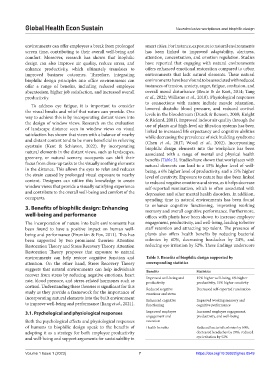
            environments can help restore cognitive function and   Table 3. Benefits of biophilic design supported by
            attention. On the other hand, Stress Recovery Theory   corresponding statistics
            suggests that natural environments can help individuals   Benefits       Statistics
            recover from stress by reducing negative emotions, heart   Improved well-being and   15% higher well-being, 6% higher
            rate, blood pressure, and stress-related hormones such as   productivity  productivity, 15% higher creativity
            cortisol. Understanding these theories is significant for this   Reduced negative   Decreased self-reported rumination
            study as they provide a framework for the importance of   emotions and stress
            incorporating natural elements into the built environment   Enhanced cognitive   Improved working memory and
            to improve well-being and performance (Jiang et al., 2021).  functioning  cognitive performance
            3.1. Psychological and physiological responses     Improved employee     Increased employee engagement,
                                                               engagement and        productivity, and well-being
            Both the psychological effects and physiological responses   retention
            of humans to biophilic design speak to the benefits of   Health benefits  Reduced bacterial colonies by 60%,
            adopting it as a strategy for both employee productivity                 decreased headaches by 24%, reduced
            and well-being and support arguments for sustainability in               eye irritation by 52%


            Volume 1 Issue 1 (2023)                         7                        https://doi.org/10.36922/ghes.0549

