


Page 79 - GHES-1-1
P. 79
Global Health Econ Sustain                                   Clinician’s attitude toward health extension program


            average of 5.3 years spent working in the healthcare sector.   sending patients back to HP from their facility. Clinician
            Degree holders constitute 50.6% of the total. More than   readiness to collaborate in HEP accounts for 88.4%. The
            three fourth (77.8%) were from health centers, and 51.5%   decision to share additional tasks with HEW at HP, such as
            of the respondents worked in rurally situated facilities.  eye care, medical abortion, and hypertension screening, is
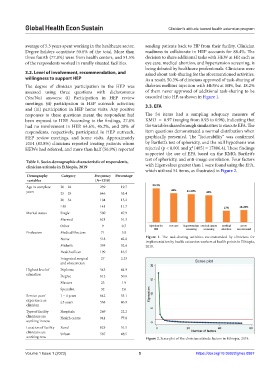
                                                               being debated by healthcare professionals. Clinicians were
            3.2. Level of involvement, recommendation, and     asked about task-sharing for the aforementioned activities.
            willingness to support HEP                         As a result, 50.3% of clinicians approved of task-sharing of
            The  degree  of clinician  participation in  the  HEP was   diabetes mellitus injection with HEWs at HPs, but 18.2%
            assessed using three questions with dichotomous    of them never approved of additional task-sharing to be
            (Yes/No) answers: (i) Participation in HEP review   cascaded into HP, as shown in Figure 1.
            meetings; (ii) participation in HEP outreach activities;   3.3. EFA
            and (iii) participation in HEP home visits. Any positive
            responses to these questions meant the respondent had   The 54 items had a sampling adequacy measure of
            been exposed to HEP. According to the findings, 27.8%   KMO  =  0.97 (ranging from 0.93 to 0.98), indicating that
            had  no  involvement  in  HEP.  64.6%,  45.2%,  and  28%  of   the variables shared enough similarities to execute EFA. The
            respondents, respectively, participated in HEP outreach,   item questions demonstrated a normal distribution when
            HEP review meetings, and home visits. Approximately   graphically  presented.  The  “factorability”  was  confirmed
            1014 (83.8%) clinicians reported treating patients whom   by Bartlett’s test of sphericity, and the null hypothesis was
                                                                                   2
            HEWs had referred, and more than half (56.9%) reported   rejected (p < 0.001 and χ  [405] = 17886.4). These findings
                                                               supported the use of EFA based on the KMO, Bartlett’s
            Table 1. Socio‑demographic characteristic of respondents,   test of sphericity, and anti-image correlation. Four factors
            clinician attitude in Ethiopia, 2019               with Eigenvalues greater than 1 were found using the EFA,
                                                               which utilized 54 items, as illustrated in Figure 2.
             Demography    Category      Frequency  Percentage
             variables                    (N=1210)
            Age in complete   20 – 24       239     19.7
            years          25 – 29          646     53.4
                           30 – 34          184     15.2
                           ≥35              141     11.7
            Marital status  Single          580     47.9
                           Married          621     51.3
                           Other            9        0.7
            Profession     Medical Doctors  71       5.9
                           Nurse            518     42.8       Figure  1.  The task-sharing activities recommended by clinicians for
                                                               implementation by health extension workers at health points in Ethiopia,
                           Midwife          395     32.6       2019.
                           Health officer   199     16.5
                           Integrated surgical   27  2.23
                           and obstetrician
            Highest level of   Diploma      543     44.9
            education      Degree           612     50.6
                           Masters          23       1.9
                           Specialist       32       2.6
            Service year/  1 – 4 years      642     53.1
            experience as   ≥5 years        568     46.9
            clinician
            Type of facility   Hospitals    269     22.2
            clinicians are   Health centre  941     77.8
            working in now
            Location of facility   Rural    623     51.5
            clinicians are   Urban          587     48.5
            working now                                        Figure 2. Scree plot of the clinician attitude factors in Ethiopia, 2019.


            Volume 1 Issue 1 (2023)                         5                        https://doi.org/10.36922/ghes.0887

