


Page 80 - GHES-1-1
P. 80
Global Health Econ Sustain                                   Clinician’s attitude toward health extension program


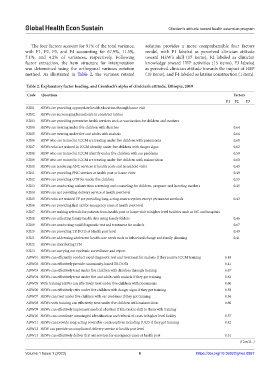
              The four factors account for 91% of the total variance,   solution provides a more comprehensible four factors
            with F1, F2, F3, and F4 accounting for 67.9%, 11.3%,   model, with F1 labeled as perceived clinician attitude
            7.1%, and 4.2% of variances, respectively. Following   toward HEW’s skill  (17 items), F2  labeled as  clinician
            factor  extraction, the  item structure  for interpretation   knowledge  toward  HEP  activities  (15  items),  F3  labeled
            was determined using the orthogonal varimax rotation   as perceived clinician attitude towards the impact of HEP
            method. As illustrated in  Table  2, the varimax rotated   (10 items), and F4 labeled as latrine construction (1 item).

            Table 2. Explanatory factor loading, and Cronbach’s alpha of clinician’s attitude, Ethiopia, 2019
             Code   Questions                                                                       Factors
                                                                                                 F1  F2   F3
            KR01  HEWs are providing appropriate health education through home visit
            KR02  HEWs are encouraging households to construct latrine
            KR03  HEWs are providing preventive health services such as vaccination for children and mothers
            KR04  HEWs are treating under five children with diarrhea                               0.64
            KR05  HEWs are treating under five and adults with malaria                              0.64
            KR06  HEW who are trained in ICCM are treating under five children with pneumonia       0.68
            KR07  HEWs who are trained in ICCM identify under five children with danger signs       0.62
            KR08  HEW who are trained in ICCM identify under five children with ear problems        0.59
            KR09  HEW who are trained in ICCM are treating under five children with malnutrition    0.60
            KR10  HEWs are rendering ANC services at health posts and household visits              0.45
            KR11  HEWs are providing PNC services at health post or home visits                     0.49
            KR12  HEWs are providing OTP for under five children                                    0.55
            KR13  HEWs are conducting malnutrition screening and counseling for children, pregnant and lactating mothers  0.45
            KR14  HEWs are not providing delivery service at health post level
            KR15  HEWs who are trained FP are providing long-acting contraceptives except permanent methods  0.43
            KR16  HEWs are providing first aid for emergency cases at health post level
            KR17  HEWs are making referrals for patients from health post or home visit to higher level facilities such as HC and hospitals
            KR18  HEWs are collecting family health data using family folders                       0.46
            KR19  HEWs are conducting rapid diagnostic test and treatment for malaria               0.67
            KR20  HEWs are providing TB DOTs at Health post level                                   0.49
            KR21  HEWs are addressing adolescent health care needs such as behavioral change and family planning  0.41
            KR22  HEWs are distributing ITN
            KR23  HEWs are carrying out epidemic surveillance and report
            ARW01 HEWs can efficiently conduct rapid diagnostic test and treatment for malaria if they receive ICCM training  0.48
            ARW02 HEWs can effectively provide community-based TB DOTs                           0.41
            ARW03 HEWs can effectively treat under five children with diarrhea through training  0.67
            ARW04 HEWs can effectively treat under five and adults with malaria if they got training  0.62
            ARW05 With training HEWs can effectively treat under five children with pneumonia    0.60
            ARW06 HEWs can effectively refer under five children with danger signs if they got training  0.58
            ARW07 HEWs can treat under five children with ear problems if they got training      0.56
            ARW08 HEWs with training can effectively treat under five children with malnutrition  0.60
            ARW09 HEWs can effectively implement medical abortion if this task is shift to them with training
            ARW10 HEWs can contribute meaningful identification and referral of cases to higher level facility   0.57
            ARW11 HEWs can provide long-acting reversible contraceptives including IUCD if they got training  0.42
            ARW12 HEW can provide uncomplicated delivery service at health post level
            ARW13 HEWs can effectively deliver first aid services for emergency cases at health post  0.51
                                                                                                       (Cont’d...)

            Volume 1 Issue 1 (2023)                         6                        https://doi.org/10.36922/ghes.0887

