


Page 82 - GHES-1-1
P. 82
Global Health Econ Sustain                                   Clinician’s attitude toward health extension program


            services to their community. On the other hand, 70.1%   40.5% of respondents believed that HEP lacked a good
            of clinicians believe HEW could not offer safe abortion   planning, monitoring, and follow-up system.
            services.
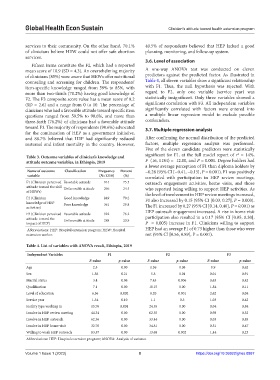
                                                               3.6. Level of association
              Fifteen items constitute the F2, which had a reported
            mean score of 10.9 (SD = 4.3). An overwhelming majority   A one-way ANOVA test was conducted on eleven
            of clinicians (85%) were aware that HEWs offer nutritional   predictors against the predicted factor. As illustrated in
            counseling and screening for children. The respondents’   Table 4, all eleven variables show a significant relationship
            item-specific knowledge ranged from 59% to 85%, with   with F1. Thus, the null hypothesis was rejected. With
            more than two-thirds (70.2%) having good knowledge of   regard to F2, only one variable (service year) was
            F2. The F3 composite score value has a mean score of 8.2   statistically insignificant. Only three variables showed a
            (SD = 2.6) and a range from 0 to 10. The percentage of   significant correlation with F3. All independent variables
            clinicians who had a favorable attitude toward specific item   significantly correlated with factors were entered into
            questions ranged from 59.5% to 90.6%, and more than   a multiple linear regression model to exclude possible
            three-forth (76.2%) of clinicians had a favorable attitude   confounders.
            toward F3. The majority of respondents (90.6%) advocated   3.7. Multiple regression analysis
            for the continuation of HEP as a government initiative,
            and 88.7% believed that HEP had significantly reduced   After confirming the normal distribution of the predicted
            maternal and infant mortality in the country. However,   factors,  multiple  regression  analysis  was  performed.
                                                               Five  of  the  eleven  candidate  predictors  were  statistically
                                                                                                      2
            Table 3. Outcome variables of clinician’s knowledge and   significant for F1, at  the full model report of  r  = 14%,
            attitude outcome variables, in Ethiopia, 2019      F  (16, 1184) =  12.00, and P = 0.001. Degree holders had
                                                               a lower average perception of F1 than diploma holders by
             Name of outcome   Classification  Frequency   Percent   −0.28 (95% CI [−0.41, −0.15], P = 0.001). F1 was positively
             variable                      (N=1210)   (%)      correlated with participation in HEP review meetings,
            F1 (Clinician perceived  Favorable attitude  914  75.5  outreach  engagement activities,  home  visits,  and  those
            attitude toward the skill   Unfavorable attitude  296  24.5  who reported being willing to support HEP activities. As
            of HEWs)                                           the level of involvement in HEP review meetings increased,
            F2 (Clinician   Good knowledge   849     70.2      F1 also increased by 0.15 (95% CI [0.03, 0.27], P = 0.000).
            knowledge of HEP   Poor knowledge  361   29.8
            activities)                                        The F1 increased by 0.27 (95% CI [0.14, 0.40], P = 0.001) as
            F3 (Clinician perceived  Favorable attitude  922  76.2  HEP outreach engagement increased. A rise in home visit
            attitude toward the   Unfavorable attitude  288  23.8  participation also resulted in a 0.17 (95% CI [0.05, 0.30],
            impact of HEP)                                     P  = 0.005) increase in F1. Clinicians willing to support
             Abbreviations: HEP: Hospital extension program; HEW: Hospital   HEP had an average F1 of 0.73 higher than those who were
            extension worker.                                  not (95% CI [0.56, 0.89], P = 0.001).
            Table 4. List of variables with ANOVA result, Ethiopia, 2019

             Independent Variables             F1                       F2                        F3
                                       F‑value     p‑value      F‑value     p‑value      F‑value       p‑value
            Age                          2.5         0.00        1.36        0.08          0.9          0.62
            Sex                         1.56         0.21        5.8         0.01         0.01          0.91
            Marital status               3.4         0.06        7.45        0.006        0.63          0.42
            Qualification                7.1         0.00       10.15        0.00         1.84          0.11
            Level of education          6.56        0.002        8.20        0.001        2.62          0.04
            Service year                1.34         0.10        1.1          0.3         1.03          0.42
            Facility type working in    15,76       0.001       24.35        0.00         0.04          0.84
            Involve in HEP review meeting   44.34    0.00       62.35        0.00         0.98          0.32
            Involve in HEP outreach     62.36        0.00       33.44        0.00         0.03          0.85
            Involve in HEP home visit   32.76        0.00       34.81        0.00         0.51          0.47
            Willing to work HEP outreach   83.57     0.00       13.68        0.002        1.44          0.23
            Abbreviations: HEP: Hospital extension program; ANOVA: Analysis of variance.


            Volume 1 Issue 1 (2023)                         8                        https://doi.org/10.36922/ghes.0887

