


Page 102 - GHES-1-2
P. 102
Global Health Econ Sustain                                   Burnout syndrome in the public and private sectors


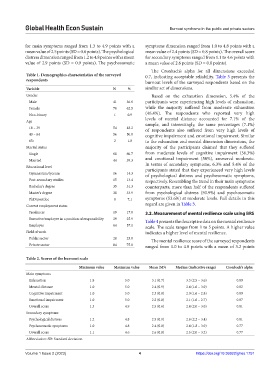
            for main symptoms ranged from 1.3 to 4.9 points with a   symptoms dimension ranged from 1.0 to 4.8 points with a
            mean value of 2.5 points (SD = 0.6 points). The psychological   mean value of 2.4 points (SD = 0.8 points). The overall score
            distress dimension ranged from 1.2 to 4.8 points with a mean   for secondary symptoms ranged from 1.1 to 4.6 points with
            value of 2.9 points (SD = 0.9 points). The psychosomatic   a mean value of 2.6 points (SD = 0.8 points).
                                                                 The Cronbach’s alpha for all dimensions exceeded
            Table 1. Demographics characteristics of the surveyed   0.7, indicating acceptable reliability. Table 3 presents the
            respondents                                        burnout levels of the surveyed respondents based on the

            Variable                             Ν     %       similar set of dimensions.
            Gender                                               Based on the exhaustion dimension, 5.4% of the
             Male                                41    36.6    participants were experiencing high levels of exhaustion,
             Female                              70    62.5    while the majority suffered from moderate exhaustion
             Non-binary                           1    0.9     (46.4%). The respondents who reported very high
            Age                                                levels  of  mental distance  accounted  for  7.1%  of  the
                                                               sample, and interestingly, the same percentages (7.1%)
             18 – 39                             54    48.2    of respondents also suffered from very high levels of
             40 – 64                             56    50.0    cognitive impairment and emotional impairment. Similar
             65+                                  2    1.8     to the exhaustion and mental dimension dimensions, the
            Marital status                                     majority of the participants claimed that they suffered
             Single                              68    60.7    from  moderate  levels  of cognitive  impairment (56.3%)
             Married                             44    39.3    and emotional impairment (58%), answered moderate.
            Educational level                                  In terms of secondary symptoms, 6.3% and 5.4% of the
                                                               participants stated that they experienced very high levels
             Gymnasium/lyceum                    16    14.3    of psychological distress and psychosomatic symptoms,
             Post-secondary studies              15    13.4    respectively. Resembling the trend in their main symptoms
             Bachelor’s degree                   35    31.3    counterparts, more than half of the respondents suffered
             Master’s degree                     38    33.9    from  psychological  distress  (50.9%)  and  psychosomatic
             PhD/postdoc                          8    7.1     symptoms (53.6%) at moderate levels. Full details in this
            Current employment status                          regard are given in Table 3.
             Freelancer                          19    17.0    3.2. Measurement of mental resilience scale using BRS
             Executive/employee in a position of responsibility  29  25.9  Table 4 presents the descriptive data on the mental resilience
             Employee                            64    57.1    scale. The scale ranges from 1 to 5 points. A higher value
            Field of work                                      indicates a higher level of mental resilience.
             Public sector                       28    25.0      The mental resilience score of the surveyed respondents
             Private sector                      84    75.0    ranged from 1.0 to 4.8 points with a mean of 3.2 points


            Table 2. Scores of the burnout scale
                                   Minimum value  Maximum value  Mean (SD)  Median (indicative range)  Cronbach’s alpha
            Main symptoms
             Exhaustion                1.8            5.0         3.1 (0.7)     3.3 (2.5 – 3.6)       0.89
             Mental distance           1.0            5.0         2.4 (0.9)     2.4 (1.6 – 3.0)       0.82
             Cognitive impairment      1.0            5.0         2.3 (0.8)     2.0 (1.6 – 2.8)       0.89
             Emotional impairment      1.0            5.0         2.2 (0.8)     2.1 (1.6 – 2.7)       0.87
             Overall score             1.3            4.9         2.5 (0.6)     2.4 (2.0 – 3.0)       0.81
            Secondary symptoms
             Psychological distress    1.2            4.8         2.9 (0.9)     2.8 (2.2 – 3.4)       0.81
             Psychosomatic symptoms    1.0            4.8         2.4 (0.8)     2.4 (1.8 – 3.0)       0.77
             Overall score             1.1            4.6         2.6 (0.8)     2.5 (2.0 – 3.2)       0.77
            Abbreviation: SD: Standard deviation.


            Volume 1 Issue 2 (2023)                         4                        https://doi.org/10.36922/ghes.1751

