


Page 100 - GHES-2-1
P. 100
Global Health Econ Sustain                                Transgenders HIV-related knowledge and risk behaviors


            Table 2. HIV Knowledge Questionnaire‑18: Questions with responses
            Question and positive response                           Correct (n [%])  Incorrect (n [%])  Do not know (n [%])
            1.   Coughing and sneezing are not a mode of transmission (T)  107 (79.3%)  20 (14.8%)  8 (5.9%)
            2.   Sharing a glass of water with someone who has HIV as a mode of   24 (17.8%)  103 (76.3%)  8 (5.9%)
                 transmission (F)
            3.   Coitus interruptus prevents HIV transmission (F)      24 (17.8%)   80 (59.3%)     31 (23%)
            4.   Anal sex is a mode of transmission (T)                117 (86.7%)  11 (8.1%)      7 (5.2%)
            5.   Showering or washing genitals after sex prevents HIV transmission (F)  10 (7.4%)  96 (71.1%)  29 (21.5%)
            6.   Pregnant women with HIV will have babies born with HIV (F)  34 (25.2%)  81 (60%)  20 (14.8%)
            7.   People with HIV quickly show serious signs of being infected (F)  22 (16.3%)  89 (65.9%)  24 (17.8%)
            8.   A vaccine is available to prevent HIV (F)             33 (24.4%)   64 (47.4%)    38 (28.1%)
            9.   Deep kissing is a mode of HIV transmission (F)        34 (25.2%)   85 (63%)      16 (11.9%)
            10.  Having sex during the menstrual cycle prevents HIV transmission (F)  21 (15.6%)  45 (33.3%)  69 (51.1%)
            11.  Female condoms can prevent HIV transmission (T)        58 (43%)    13 (9.6%)     64 (47.4%)
            12.  Natural skin condoms are more effective than latex condoms (F)  15 (11.1%)  99 (73.3%)  21 (15.6%)
            13.  Taking antibiotics prevents HIV infection (F)         21 (15.6%)   82 (60.7%)    32 (23.7%)
            14.  Multiple partners increase HIV risk (T)               124 (91.9%)  8 (5.9%)       3 (2.2%)
            15.  Taking a test 1 week after sex indicates infection (F)  12 (8.9%)  93 (68.9%)    30 (22.2%)
            16.  Sharing swimming pools and hot tubes with a person with HIV infection can   21 (15.6%)  93 (68.9%)  21 (15.6%)
                 result in infection (F)
            17.  Oral sex as a mode of HIV transmission (T)            109 (80.7%)  14 (10.4%)     12 (8.9%)
            18.  Use of vaseline or baby oils with condoms lowers risk for HIV transmission (F)  22 (16.3%)  78 (57.8%)  35 (25.9%)

            Table 3. Association of HIV‑related knowledge with
            sociodemographic variables                                    77
            Variables   Answer HIV‑related Knowledge df  Χ 2  p‑value
                                                                                                58
                                Good     Poor
            Sex activity   Yes    38      39  1 4.321  0.028
            (open street)   No    39      19
            Barrier use  Always   36      13  1 8.476  0.003
                      Never       41      45
                                                                             57%                   43%
                                                                      Good Knowledge         Poor Knowledge
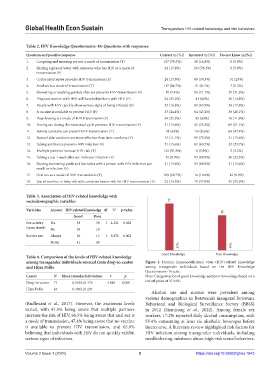
            Table 4. Comparison of the levels of HIV‑related knowledge
            among transgender individuals sourced from drop‑in‑center   Figure  1.  Human immunodeficiency virus (HIV)-related knowledge
            and Hijra Pollis                                   among transgender individuals based on the HIV Knowledge
                                                               Questionnaire-18 scale.
            Center      N  Mean±standard deviation  t  p       Note: Categorization of good knowledge and poor knowledge based on a
            Drop-in-center  71  0.5548±0.176   4.816  0.000    cut-off point of 47.44%.
            Hijra Pollis  64    0.3863±0.224
                                                                 Alcohol use and misuse were prevalent among
                                                               various demographics in Botswana’s inaugural Botswana
            (Budhwani  et al., 2017). However, the awareness levels   Behavioral and Biological Surveillance Survey (BBSS)
            varied, with 91.9% being aware that multiple partners   in  2012  (Siamisang  et al.,  2022).  Among  female  sex
            increase the risk of HIV, 86.5% being aware that anal sex is   workers, 17.2% reported daily alcohol consumption, with
            a mode of transmission, 47.4% being aware that no vaccine   55.4%  consuming  at  least  six  alcoholic  beverages  before
            is available to prevent HIV transmission, and 65.9%   intercourse. A literature review highlighted risk factors for
            believing that individuals with HIV do not quickly exhibit   HIV infection among transgender individuals, including
            serious signs of infection.                        needle sharing, substance abuse, high-risk sexual behaviors,


            Volume 2 Issue 1 (2024)                         5                        https://doi.org/10.36922/ghes.1643

