


Page 99 - GHES-2-1
P. 99
Global Health Econ Sustain                                Transgenders HIV-related knowledge and risk behaviors


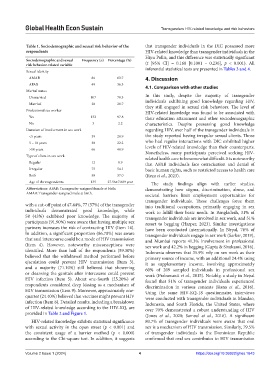
            Table 1. Sociodemographic and sexual risk behavior of the   that transgender individuals in the DIC possessed more
            respondents                                        HIV-related knowledge than transgender individuals in the
                                                               Hijra Pollis, and this difference was statistically significant
            Sociodemographic and sexual   Frequency (n)  Percentage (%)
            risk behavior‑related variable                     (t  [95% CI] = 0.168 [0.1001 – 0.236],  p  < 0.001). All
            Sexual identity                                    inferential statistical tests are presented in Tables 3 and 4.
             AMAB                       86         63.7        4. Discussion
             AFAB                       49         36.3        4.1. Comparison with other studies
            Marital status
             Unmarried                  107        79.3        In this study, despite the majority of transgender
             Married                    28         20.7        individuals exhibiting good knowledge regarding HIV,
                                                               they still engaged in sexual risk behaviors. The level of
            Professional sex worker                            HIV-related knowledge was found to be associated with
             Yes                        132        97.8        their education attainment and other sociodemographic
             No                         3          2.2         characteristics. Despite possessing good knowledge
            Duration of involvement in sex work                regarding HIV, over half of the transgender individuals in
             <5 years                   39         28.9        the study reported having irregular sexual clients. Those
             5 – 10 years               30         22.2        who had regular interactions with DIC exhibited higher
             >10 years                  66         48.9        levels of HIV-related knowledge than their counterparts.
            Type of client in sex work                         Nonetheless,  many  participants  perceived  seeking  HIV-
                                                               related health care to be somewhat difficult. It is noteworthy
             Regular                    12         8.9         that AFAB individuals face ostracization and denial of
             Irregular                  73         54.1        basic human rights, such as restricted access to health care
             Both                       50         37.0        (Reza et al., 2023).
             Age of the respondents     135    27.56±7.889 year  The study findings align with earlier studies,
            Abbreviations: AFAB: Transgender-assigned female at birth;   demonstrating how stigma, discrimination, abuse, and
            AMAB: Transgender-assigned male at birth.          societal barriers limit employment opportunities for
                                                               transgender individuals. These challenges force them
            with a cut-off point of 47.44%, 77 (57%) of the transgender   into traditional occupations, primarily engaging in sex
            individuals demonstrated good knowledge, while     work to fulfill their basic needs. In Bangladesh, 31% of
            58  (43%) exhibited poor knowledge. The majority of   transgender individuals are involved in sex work, and 51%
            participants (91.90%) were aware that having multiple sex   resort to begging (Harper, 2023). Similar investigations
            partners increases the risk of contracting HIV (Item 14).   have been conducted internationally. In Nepal, 76% of
            In addition, a significant proportion (86.70%) was aware   transgender individuals engage in sex work (Sarker, 2019),
            that anal intercourse could be a mode of HIV transmission   and  Mumbai reports  41.3% involvement in  professional
            (Item  4).  However,  noteworthy  misconceptions  were   sex work and 42.2% in begging (Gupta & Sivakami, 2016).
            identified. More than half of the respondents (59.30%)   Indonesia observes that 35.9% rely on sex work as their
            believed that the withdrawal method performed before   primary source of income, with an additional 24.4% using
            ejaculation could prevent HIV transmission (Item 3),   it as supplementary income, involving approximately
            and a majority (71.10%) still believed that showering   60% of 209  sampled individuals in professional sex
            or cleansing the genitals after intercourse could prevent   work (Prabawanti et al., 2015). Notably, a study in Nepal
            HIV infection (Item 5). About one-fourth (25.20%) of   found that 51% of transgender individuals experienced
            respondents considered deep kissing as a mechanism of   discrimination in various contexts (Rana  et  al., 2016).
            HIV transmission (Item 9). Moreover, approximately one-  Using the same HIV-KQ-18 questionnaire, interviews
            quarter (24.40%) believed that vaccines might prevent HIV   were conducted with transgender individuals in Mandao,
            infection (Item 8). Detailed results, including a breakdown   Indonesia, and South Florida, the United States, where
            of HIV-related knowledge according to the HIV-KQ, are   over 70% demonstrated a robust understanding of HIV
            provided in Table 2 and Figure 1.                  (Jones  et al., 2020; Samsul  et al., 2016). A  significant
              HIV-related knowledge exhibits statistical significance   80.7% of transgender individuals were aware that oral
            with sexual activity in the open street (p  < 0.001) and   sex is a mechanism of HIV transmission. Similarly, 79.5%
            the consistent usage of a barrier method (p  < 0.000)   of transgender individuals in the Dominican Republic
            according to the Chi-square test. In addition, it suggests   confirmed that oral sex contributes to HIV transmission


            Volume 2 Issue 1 (2024)                         4                        https://doi.org/10.36922/ghes.1643

