


Page 149 - GHES-2-1
P. 149
Global Health Econ Sustain                                   Utilizing REDCap in a cardiac rehabilitation service


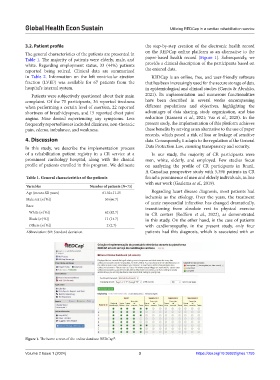
            3.2. Patient profile                               the step-by-step creation of the electronic health record

            The general characteristics of the patients are presented in   on the REDCap online platform as an alternative to the
            Table 1. The majority of patients were elderly, male, and   paper-based health record (Figure 1). Subsequently, we
            white. Regarding employment status, 33  (44%) patients   provide a clinical description of the participants based on
            reported being retired. Clinical data are summarized   the entered data.
            in  Table 2. Information on the left ventricular ejection   REDCap is an online, free, and user-friendly software
            fraction (LVEF) was  available  for  67  patients  from  the   that has been increasingly used for the secure storage of data
            hospital’s internal system.                        in epidemiological and clinical studies (Garcia & Abrahão,

              Patients were subjectively questioned about their main   2021). Its implementation and numerous functionalities
            complaint. Of the 75 participants, 36 reported tiredness   have been described in several works encompassing
            when performing a certain level of exertion, 22 reported   different populations and objectives, highlighting the
            shortness of breath/dyspnea, and 15 reported chest pain/  advantages of data sharing, study organization, and bias
            angina. Nine denied experiencing any symptoms. Less   reduction (Kianersi  et al., 2021; Vaz  et al., 2020). In the
            frequently reported issues included dizziness, non-thoracic   present study, the implementation of this platform achieves
            pain, edema, imbalance, and weakness.              these benefits by serving as an alternative to the use of paper
                                                               records, which posed a risk of loss or leakage of sensitive
            4. Discussion                                      data. Consequently, it adapts to the regulation of the General
            In this study, we describe the implementation process   Data Protection Law, ensuring transparency and security.
            of a rehabilitation patient registry in a CR service at a   In our study, the majority of CR participants were
            prominent cardiology hospital, along with the clinical   men, white, elderly, and employed. Few studies focus
            profile of patients enrolled in this program. We delineate   on analyzing the profile of CR participants in Brazil.
                                                               A Canadian prospective study with 5,396 patients in CR
            Table 1. General characteristics of the patients   found a prominence of men and elderly individuals, in line
                                                               with our work (Gaalema et al., 2019).
            Variables                  Number of patients (N=75)
            Age (mean±SD years)              61.52±11.25         Regarding heart disease diagnosis, most patients had
            Male sex (n [%])                  50 (66.7)        ischemia as the etiology. Over the years, the treatment
                                                               of acute myocardial infarction has changed dramatically,
            Race                                               transitioning from absolute rest to physical exercise
             White (n [%])                    62 (82.7)        in CR centers (Redfern  et al., 2022), as demonstrated
             Black (n [%])                    11 (14.7)        in this study. On the other hand, in the case of patients
             Others (n [%])                   2 (2.7)          with cardiomyopathy, in the present study, only four
            Abbreviation: SD: Standard deviation.              patients had this diagnosis, which is associated with an


            Figure 1. The home screen of the online database REDCap .
                                                 ®

            Volume 2 Issue 1 (2024)                         3                        https://doi.org/10.36922/ghes.1755

