


Page 150 - GHES-2-1
P. 150
Global Health Econ Sustain                                   Utilizing REDCap in a cardiac rehabilitation service


            Table 2. Patients clinical data                    Table 2. (Continued)
            Clinical data              Number of patients (N=75)  Clinical data           Number of patients (N=75)
             Diagnosis                                          Smoking                          1 (1.3)
               Etiological                                      Smoking history                  39 (52.0)
                Ischemic                      52 (69.3)         Alcoholism                       20 (26.7)
                Valvular                      6 (8.0)           Weekly amount (mean±SD doses)   2.19±1.51
                Congenital                    6 (8.0)           Heart disease family history     57 (76.0)
                Other                         11 (14.7)        Note: Values are expressed as absolute (n) and relative (%) numbers
             Cardiomyopathy                   4 (5.3)          unless otherwise specified. Abbreviations: CCS Angina Class:
                                                               Cardiovascular Society Classification of Angina; LVEF: Left ventricular
               Hypertrophic                   1 (25.0)         ejection fraction; NYHA CF: New York Heart Association Functional
               Restrictive                      0              Classification; SD: Standard deviation.
               Dilated                        3 (75.0)
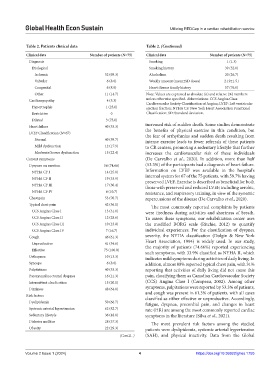
             Heart failure                    40 (53.3)        increased risk of sudden death. Some studies demonstrate
             LVEF Classification (N=67)                        the benefits of physical exercise in this condition, but
                                                               the fear of arrhythmias and sudden death resulting from
                Normal                        40 (59.7)        intense exercise leads to fewer referrals of these patients
                Mild dysfunction              12 (17.9)        to CR centers, promoting a sedentary lifestyle that further
                Moderate/Severe dysfunction   15 (22.4)        increases the cardiovascular risk of these individuals
            Current symptoms                                   (De Carvalho  et al., 2020). In addition, more than half
             Dyspnea on exertion             56 (74.66)        (53.3%) of the participants had a diagnosis of heart failure.
               NYHA CF I                      14 (25.0)        Information on LVEF was available in the hospital’s
               NYHA CF II                     19 (33.9)        internal system for 67 of the 75 patients, with 59.7% having
                                                               preserved LVEF. Exercise is described as beneficial for both
               NYHA CF III                    17 (30.4)        those with preserved and reduced LVEF, including aerobic,
               NYHA CF IV                     6 (10.7)         resistance, and respiratory training, in view of the systemic
             Chest pain                       53 (70.7)        repercussions of the disease (De Carvalho et al., 2020).
             Typical chest pain               42 (56.0)          The most commonly reported complaints by patients
               CCS Angina Class I             13 (31.0)        were tiredness during activities and shortness of breath.
               CCS Angina Class II            12 (28.6)        To assess these symptoms, our rehabilitation center uses
               CCS Angina Class III           10 (23.8)        the modified BORG scale (Ritchie, 2012) to quantify
               CCS Angina Class IV            7 (16.7)         individual experiences. For the classification of dyspnea
             Cough                            46 (61.3)        severity, the NYHA classification (Dolgin & New  York
               Unproductive                   41 (54.6)        Heart Association, 1994) is widely used. In our study,
                                                               the majority of patients (74.66%) reported experiencing
               Effective                     75 (100.0)        such symptoms, with 33.9% classified as NYHA II, which
             Orthopnea                        10 (13.3)        indicates mild symptoms during activities of daily living. In
             Syncope                          6 (8.0)          addition, almost 80% reported typical chest pain, with 31%
             Palpitations                     40 (53.3)        reporting that activities of daily living did not cause this
             Paroxysmal nocturnal dyspnea     16 (21.3)        pain, classifying them as Canadian Cardiovascular Society
             Intermittent claudication        15 (20.0)        (CCS) Angina Class  I (Campeau, 2002). Among other
             Dizziness                        48 (64.0)        symptoms, palpitations were reported by 53.3% of patients,
            Risk factors                                       and cough was present in 61.3% of patients, with all cases
                                                               classified as either effective or unproductive. Accordingly,
             Dyslipidemia                     50 (66.7)        fatigue,  dyspnea,  precordial  pain,  and  changes  in  heart
             Systemic arterial hypertension   62 (82.7)        rate (HR) are among the most commonly reported cardiac
             Sedentary lifestyle              36 (48.0)        symptoms in the literature (Silva et al., 2021).
             Diabetes mellitus                28 (37.3)          The most prevalent risk factors among the studied
             Obesity                          22 (29.3)        patients were dyslipidemia, systemic arterial hypertension
                                                    (Cont’d...)  (SAH), and physical inactivity. Data from the Global


            Volume 2 Issue 1 (2024)                         4                        https://doi.org/10.36922/ghes.1755

