


Page 56 - GHES-2-1
P. 56
Global Health Econ Sustain                                          Quantum Data Lake for epidemic analysis


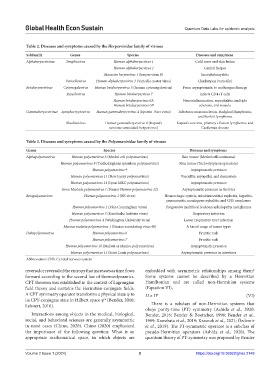
            Table 2. Diseases and symptoms caused by the Herpesviridae family of viruses
            Subfamily          Genus                   Species                      Diseases and symptoms
            Alphaherpesvirinae  Simplexvirus     Human alphaherpesvirus 1           Cold sores and skin lesion
                                                 Human alphaherpesvirus 2               Genital herpes
                                             Macacine herpesvirus 1 (herpes virus B)   Encephalomyelitis
                             Varicellovirus  Human alphaherpesvirus 3 (Varicella-zoster virus)  Chickenpox (varicella)
            Betaherpesvirinae  Cytomegalovirus  Human betaherpesvirus 5 (human cytomegalovirus)  From asymptomatic to multiorgan damage
                             Roseolovirus         Human betaherpesvirus 7             Infects CD4+T cells
                                                 Human betaherpesvirus 6A      Neuroinflammation, encephalitis, multiple
                                                 Human betaherpesvirus 6B             sclerosis, and roseola
            Gammaherpesvirinae Lymphocryptovirus  Human gammaherpesvirus 4 (Epstein–Barr virus)  Infectious mononucleosis, Hodgkin’s lymphoma,
                                                                                     and Burkitt lymphoma
                             Rhadinovirus     Human gammaherpesvirus 8 (Kaposi’s   Kaposi’s sarcoma, primary effusion lymphoma, and
                                               sarcoma-associated herpesvirus)         Castleman disease


            Table 3. Diseases and symptoms caused by the Polyomaviridae family of viruses
            Genus                            Species                              Diseases and symptoms
            Alphapolyomavirus   Human polyomavirus 5 (Merkel cell polyomavirus)  Skin tumor (Merkel cell carcinoma)
                           Human polyomavirus 8 (Trichodysplasia spinulosa polyomavirus)  Skin lesion (Trichodysplasia spinulosa)
                                        Human polyomavirus 9                      Asymptomatic presence
                               Human polyomavirus 13 (New Jersey polyomavirus)  Vasculitis, myopathy, and dermatosis
                               Human polyomavirus 14 (Lyon IARC polyomavirus)     Asymptomatic presence
                           Sorex Mastade polyomavirus 1 (former Human polyomavirus 12)  Asymptomatic presence in the liver
            Betapolyomavirus         Human polyomavirus 1 (BK virus)   Hemorrhagic cystitis, tubulointerstitial nephritis, hepatitis,
                                                                        pneumonitis, meningoencephalitis, and CNS neoplasms
                                Human polyomavirus 2 (John Cunningham virus)  Progressive multifocal leukoencephalopathy and gliomas
                                Human polyomavirus 3 (Karolinska Institute virus)  Respiratory infection
                              Human polyomavirus 4 (Washington University virus)  Lower respiratory tract infection
                            Macaca mulatta polyomavirus 1 (Simian vacuolating virus 40)  A broad range of tumor types
            Deltapolyomavirus           Human polyomavirus 6                          Pruritic rash
                                        Human polyomavirus 7                          Pruritic rash
                             Human polyomavirus 10 (Malawi or Mexico polyomavirus)  Asymptomatic presence
                               Human polyomavirus 11 (Saint Louis polyomavirus)  Asymptomatic presence in intestines
            Abbreviation: CNS: Central nervous system

            reversal or reversal of the entropy that increases as time flows   embedded with asymmetric relationships among them?
            forward according to the second law of thermodynamics.   Some systems cannot be described by a Hermitian
            CPT theorem was established in the context of Lagrangian   Hamiltonian and are called non-Hermitian systems
            field theory and contains the Hermitian-conjugate fields.   (Equation VI),
            A CPT symmetry operator transforms a physical state ψ to   H ≠ H †                            (VI)
            its CPT-conjugate state in Hilbert space ψ* (Bender, 2016;
            Lehnert, 2016).                                      There is a subclass of non-Hermitian systems that
                                                               obeys parity-time (PT) symmetry (Ashida  et  al., 2020;
              Interactions among objects in the medical, biological,   Bender, 2016; Bender & Boettcher, 1998; Bender  et al.,
            social, and behavioral sciences are generally asymmetric   1999; Kawabata et al., 2019; Krasnok et al., 2021; Özdemir
            in most cases (Chino, 2020). Chino (2020) emphasized   et al., 2019). The PT-symmetric operator is a subclass of
            the importance of the following question: What is an   pseudo-Hermitian operators (Ashida  et al., 2020). The
            appropriate mathematical  space,  in which objects  are   quantum theory of PT-symmetry was proposed by Bender


            Volume 2 Issue 1 (2024)                         5                        https://doi.org/10.36922/ghes.2148

