


Page 137 - GHES-2-2
P. 137
Global Health Econ Sustain                                      Improving health of older adults in rural Uganda


            satisfaction with the Kisoro Elders Project and significant   3.3. Results of the GHA
            improvements in quality of life. However, the methodology   A total of 3,615 older adults were interviewed, with
            was flawed, and the results were not published.    complete datasets reported for 3,551 individuals. Almost
              Depression groups were surprisingly successful based   all older adults self-reported their information; however,
            on qualitative reporting. Older adults almost uniformly   for those unable to do so, data were gathered from a family
            reported great improvement in effect, with some likening   member. Some older adults, especially women, did not
            their improvement to a miracle, and requested that the   know their exact age. In such cases, best guesses were
            groups  be  continued.  Currently,  a  continuation  of  the   made by comparing life events with historical and family
            pilot groups takes place on a monthly basis, and training is   milestones. Reported ages ranged from 60 to over 105. See
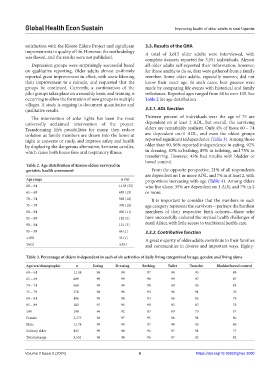
            occurring to allow the formation of new groups in multiple   Table 2 for age distribution.
            villages. A study is ongoing to document quantitative and
            qualitative results.                               3.3.1. ADL function

              The intervention of solar lights has been the most   Thirteen percent of individuals over the age of 75 are
            universally acclaimed intervention of the project.   dependent on at least 2 ADL, but overall, the surviving
            Transforming life’s possibilities for many, they reduce   elders are remarkably resilient. Only 4% of those 60 – 74
            isolation as family members are drawn into the home at   are  dependent  on>1  ADL,  and  even  the  oldest  groups
            night to converse or study, and improve safety and health   reported significant independence (Table 3). Among those
            by displacing the dangerous alternative, kerosene candles,   older than 90, 96% reported independence in eating, 92%
            which cause both house fires and respiratory illness.  in dressing, 83% in bathing, 89% in toileting, and 75% in
                                                               transferring.  However,  43%  had  trouble  with  bladder  or
                                                               bowel control.
            Table 2. Age distribution of Kisoro elders surveyed in
            geriatric health assessment                          From the opposite perspective, 21% of all respondents
                                                               are dependent on 1 or more ADL, and 7% in at least 2, with
            Age range                                n (%)     proportions increasing with age (Table 4). Among elders
            60 – 64                                1,138 (32)  who live alone, 35% are dependent on 1 ADL and 7% in 2
            65 – 69                                 689 (19)   or more.
            70 – 74                                 568 (16)     It is important to consider that the numbers in each
            75 – 79                                 370 (10)   age category represent the survivors—perhaps the hardiest
            80 – 84                                 406 (11)   members of their respective birth cohorts—those who
            85 – 89                                 182 (5)    have successfully endured the myriad health challenges of
            90 – 94                                 121 (3)    rural Africa with little access to traditional health care.
            95 – 99                                 44 (1)     3.3.2. Contributive function
            ≥100                                    33 (1)     A great majority of older adults contribute to their families
            Total                                   3,551      and communities in diverse and important ways. Eighty-


            Table 3. Percentage of elders independent in each of six activities of daily living categorized by age, gender, and living alone
            Age/sex/demographic  n       Eating   Dressing    Bathing   Toilet    Transfer   Bladder/bowel control
            60 – 64             1,138     98         98         97        98        95              88
            65 – 69             689       99         99         98        99        97              87
            70 – 74             568       99         99         98        99        95              83
            75 – 79             370       98         96         94        96        91              76
            80 – 84             406       99         98         93        96        85              75
            85 – 89             182       97         95         90        93        87              75
            ≥90                 198       96         92         83        89        75              57
            Female              2,373     98         97         95        96        91              80
            Male                1,178     99         99         97        98        95              86
            Solitary elder      443       99         98         96        97        91              77
            Total/average       3,551     98         98         96        97        92              82


            Volume 2 Issue 2 (2024)                         6                        https://doi.org/10.36922/ghes.3000

