


Page 138 - GHES-2-2
P. 138
Global Health Econ Sustain                                      Improving health of older adults in rural Uganda


            one percent of older adults in all age groups perform five or   viable, and could be implemented by experienced VHW
            six of the contributive functions listed in Table 5.  staff. Instead of adopting the traditional research model
              The periodic GHAs, linked to the biannual health   involving single-variable interventions with treatment and
            census, identify older adults who have not yet undergone   control groups and measuring longitudinal outcomes, we
            screening. In the future, these assessments will incorporate   opted for a design that sought to establish the feasibility of
            other important issues such as caregiver burden, the need   our original intention within the highly variable settings
            for social support beyond family, and evidence of elder   of rural villages. The limited availability of quantitative
            abuse. Since VHWs have access to the GHA–CFS, they can   outcome data is partly due to this chosen model and also
            facilitate targeted activities based on this data. Information   due to the challenges faced in data acquisition, input, and
            for each elder is promptly incorporated in the VHW’s   analysis posed by VHWs’ low educational levels and the
            family binder, located adjacent to the Family Health Sheet.   lack of research funding for longitudinal data.
            In addition, the VHWs maintain another field book, the   Functional independence is widely accepted in
            POCR, which lists all village elders and the screenings and   geriatrics as the hallmark of successful aging. The benefits of
            benefits they have received.                       interventions aimed at improving vision, hearing, mobility,
                                                               and mood, and reducing pain and social isolation—all
            4. Discussion                                      factors  contributing  to  functional  status—were  deemed
            The Kisoro Elders Project was conceived with the aim of   to be well-established. However, this study did not aim
            maximizing the  benefits for  older  adults in  the  villages   to quantify the extent to which individual improvements
            served by VHWs in the Kisoro District. This goal of   in quality of life contributed to overall improvements in
            achieving maximum benefit hinged on interventions that   functional status.
            could immediately produce positive effects, were financially   One of the main goals of the GHA was to demonstrate
                                                               that despite functional dependencies, older adults living in
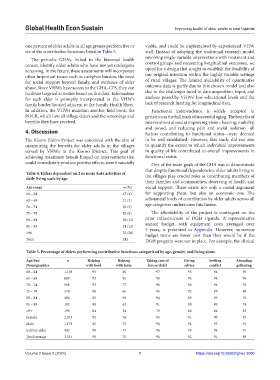
            Table 4. Elders dependent on 2 or more Katz activities of
            daily living scale by age                          the villages play crucial roles as contributing members of
                                                               their families and communities, deserving of health and
            Age range                                 n (%)    social support. There exists not only a moral argument
            60 – 64                                  47 (4)    for supporting them, but also an economic one. The
            65 – 69                                  21 (3)    substantial levels of contribution by older adults across all
            70 – 74                                  20 (3)    age categories underscores this theme.
            75 – 79                                  29 (8)      The affordability of the project is contingent on the
            80 – 84                                  50 (12)   prior infrastructure of DGH Uganda. A  representative
            85 – 89                                  24 (13)   annual budget, with equipment costs averaged over
                                                               5  years, is presented in  Appendix. However, numerous
            ≥90                                      52 (26)   budget items are lower cost than they would be if the
            Total                                    243       DGH program were not in place. For example, the clinical

            Table 5. Percentage of elders performing contributive functions categorized by age, gender, and living alone
            Age/Sex/         n        Helping      Helping     Taking care of   Giving    Settling   Attending
            Demographics              with food   with farm     house/child    advice     conflict    gathering
            60 – 64         1,138       95           88            97            95         94          95
            65 – 69         689         93           85            98            95         94          96
            70 – 74         568         93           77            98            96         94          93
            75 – 79         370         88           65            95            92         89          88
            80 – 84         406         85           58            94            89         89          76
            85 – 89         182         80           43            91            80         80          74
            ≥9+             198         64           34            78            66         64          43
            Female          2,373       92           76            95            91         90          87
            Male            1,178       85           73            96            94         93          91
            Solitary elder  443         90           77            96            95         94          91
            Total/average   3,551       90           75            96            92         91          88


            Volume 2 Issue 2 (2024)                         7                        https://doi.org/10.36922/ghes.3000

