


Page 152 - GHES-2-2
P. 152
Global Health Econ Sustain                                                  Disparities in cancer outcomes


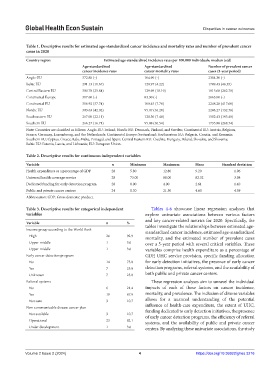
            Table 1. Descriptive results for estimated age‑standardized cancer incidence and mortality rates and number of prevalent cancer
            cases in 2020
            Country region                   Estimated age‑standardized incidence rates per 100.000 individuals, median (std)
                                    Age‑standardized          Age‑standardized            Number of prevalent cancer
                                    cancer incidence rates    cancer mortality rates      cases (5‑year period)
            Anglo-EU                372.80 (-)                104.90 (-)                  2304.30 (-)
            Baltic EU               291.13 (11.67)            120.97 (4.22)               1789.43 (46.35)
            Central Eastern EU      300.78 (25.84)            129.98 (18.10)              1815.68 (262.78)
            Continental Europe      317.60 (-)                83.30 (-)                   2663.00 (-)
            Continental EU          316.92 (37.74)            100.45 (7.70)               2248.28 (417.60)
            Nordic EU               303.63 (42.02)            95.07 (16.20)               2286.27 (132.76)
            Southeastern EU         267.00 (22.11)            128.30 (7.48)               1502.43 (193.48)
            Southern EU             266.27 (16.71)            95.88 (10.54)               1735.88 (268.74)
            Note: Countries are classified as follows: Anglo-EU: Ireland; Nordic EU: Denmark, Finland, and Sweden; Continental EU: Austria, Belgium,
            France, Germany, Luxembourg, and the Netherlands; Continental Europe: Switzerland; Southeastern EU: Bulgaria, Croatia, and Romania;
            Southern EU: Cyprus, Greece, Italy, Malta, Portugal, and Spain; Central Eastern EU: Czechia, Hungary, Poland, Slovakia, and Slovenia;
            Baltic EU: Estonia, Latvia, and Lithuania; EU: European Union.

            Table 2. Descriptive results for continuous independent variables
            Variable                             n      Minimum       Maximum       Mean       Standard deviation
            Health expenditure as a percentage of GDP  28  5.80       12.80         9.20             1.96
            Universal health coverage service   28      73.00         88.00         82.32            3.98
            Dedicated funding for early detection program  28  0.00   4.00          2.61             1.40
            Public and private cancer centers   24      0.30          21.50         4.60             4.59
            Abbreviation: GDP: Gross domestic product.

            Table 3. Descriptive results for categorical independent   Tables  4-6 showcase linear regression analyses that
            variables                                          explore univariate associations between various factors
                                                               and key cancer-related metrics for 2020. Specifically, the
            Variable                          n        %       tables investigate the relationships between estimated age-
            Income group according to the World Bank           standardized cancer incidence, estimated age-standardized
             High                             26       92.9    mortality, and the estimated number of prevalent cases
             Upper-middle                     1        3.6     over a 5-year period with several critical variables. These
             Upper-middle                     1        3.6     variables comprise health expenditure as a percentage of
            Early cancer detection program                     GDP, UHC service provision, specific funding allocation
             No                               14       75.0    for early detection initiatives, the presence of early cancer
             Yes                              7        25.0    detection programs, referral systems, and the availability of
             Unknown                          7        25.0    both public and private cancer centers.
            Referral systems                                     These regression analyses aim to unravel the individual
             No                               6        21.4    impacts of each of these factors on cancer incidence,
             Yes                              19       67.9    mortality, and prevalence. The inclusion of diverse variables
             Not sure                         3        10.7    allows for a nuanced understanding of the potential
            Non-communicable disease cancer plan               influence  of  health-care  expenditure,  the  extent  of  UHC,
                                                               funding dedicated to early detection initiatives, the presence
             Not available                    3        10.7    of early cancer detection programs, the efficiency of referral
             Operational                      23       82.1    systems, and the availability of public and private cancer
             Under development                1        3.6     centers. By analyzing these univariate associations, the study


            Volume 2 Issue 2 (2024)                         4                        https://doi.org/10.36922/ghes.3216

