


Page 22 - GHES-2-3
P. 22
Global Health Economics and
            Sustainability
                                                                                    AI in antibiotic prescribing in Nigeria


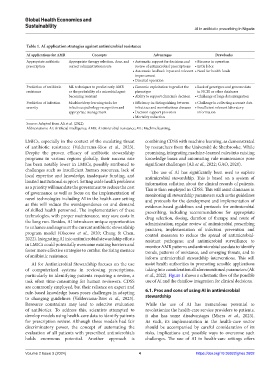
            Table 1. AI application strategies against antimicrobial resistance
            AI applications for AMR     Concepts                  Advantages                 Drawbacks
            Appropriate antibiotic   Appropriate therapy selection, dose, and  •  Automatic support for decisions and   • Biasness in operation
            prescription      correct administration route  review of antimicrobial prescriptions  • Little labor
                                                         •  Automatic feedback input and relevant  • Need for health funds
                                                          improvement
                                                         • Directed operation
            Prediction of antibiotic   ML techniques to predict early AMR   •  Genomic exploitation to predict the   •  Lack of genotypes and genome data
            resistance        or the probability of a microbial agent   phenotype    in NCBI or other databases
                              becoming resistant         • Ability to support clinician’s decision  • Challenge of large data integration
            Prediction of infection   Machine/deep learning tools for   •  Efficiency in distinguishing between   • Challenge in collecting accurate data
            severity          infectious pathology recognition and   infectious and noninfectious diseases  •  Insufficient relevant laboratory
                              appropriate management     • Decision support provision  information
                                                         • Mortality reduction
            Source: Adapted from Ali et al. (2022).
            Abbreviations: AI: Artificial intelligence; AMR: Antimicrobial resistance; ML: Machine learning.


            LMICs, especially in the context of the escalating threat   combining CDSS with machine learning, as demonstrated
            of antibiotic resistance (Valderrama-Rios  et al., 2023).   by researchers from the Université de Sherbrooke. While
            Despite the proven efficacy of antibiotic stewardship   promising, integrating machine-learned rules into existing
            programs in various regions globally, their success rate   knowledge bases and automating rule maintenance pose
            has been notably lower in LMICs, possibly attributed to   significant challenges (Ali et al., 2022; GAO, 2020).
            challenges such as insufficient human resources, lack of   The use of AI has significantly been  used to explore
            local expertise  and knowledge, inadequate funding, and   antimicrobial stewardship. This is based on a system of
            limited institutional support. Setting aside health problems   information collation about the clinical records of patients.
            as a priority will mandate the government to reduce the cost   This is then employed in CDSS. This will assist clinicians in
            of governance as well as focus on the implementation of   monitoring all stewardship parameters such as the guidelines
            novel technologies including AI in the health-care setting   and protocols for the development and implementation of
            as this will reduce the overdependence on and demand   evidence-based guidelines and protocols for antimicrobial
            of skilled health personnel. The implementation of these   prescribing, including recommendations  for appropriate
            technologies, with proper maintenance, may save costs in   drug  selection,  dosing,  duration  of  therapy,  and route  of
            the long run. Besides, AI introduces unique opportunities   administration; regular review of antimicrobial prescribing
            to enhance and augment the current antibiotic stewardship   practices; implementation of infection prevention and
            program model (Okeowo  et  al., 2020; Chang & Chen,   control measures to reduce the spread of antimicrobial-
            2022). Integrating AI into antimicrobial stewardship efforts   resistant pathogens; and antimicrobial surveillance to
            in LMICs could potentially overcome existing barriers and   monitor AMR patterns and antimicrobial use data to identify
            foster more effective strategies to combat the rising menace   trends, patterns of resistance, and emerging threats, and to
            of antibiotic resistance.                          inform antimicrobial stewardship interventions. This will
              AI for Antimicrobial Stewardship focuses on the use   assist health authorities in promoting sensible applications
            of computerized systems in reviewing prescriptions,   taking into consideration all aforementioned parameters (Ali
            particularly in identifying patients requiring a review, a   et al., 2022). Figure 1 shows a schematic flow of the possible
            task often time-consuming for human reviewers. CDSS   use of AI and the dataflow integration for clinical decisions.
            are commonly employed, but their reliance on expert and
            rule-based knowledge bases poses challenges in adapting   6.1. Pros and cons of using AI in antimicrobial
            to changing guidelines (Valderrama-Rios  et al., 2023).   stewardship
            Resource  constraints may  lead  to  selective  evaluation   While  the use of AI has tremendous potential to
            of  antibiotics.  To  address  this,  scientists  attempted  to   revolutionize the health-care service providers to patients,
            develop models using health-care data to identify patients   it also has some disadvantages (Marra  et al., 2023).
            for prescription review. Although these models had fair   As such, its implementation in the health-care sector
            discriminatory power, the concept of automating the   should be accompanied by careful consideration of its
            evaluation of all patients with prescribed antimicrobials   risks, implications and possible ways to overcome such
            holds enormous potential. Another approach is      challenges. The use of AI in health-care settings offers


            Volume 2 Issue 3 (2024)                         4                        https://doi.org/10.36922/ghes.2602

