


Page 100 - GHES-2-4
P. 100
Global Health Economics and
            Sustainability
                                                                                  Sustainable, competent health trainers


            discussions of real-life clinical situations presented by the   knowledge and skills (abdominal palpation, newborn
            Palghar MTs. The essential skills included plotting and   resuscitation, and eclampsia management) of the trainee
            interpretation of partographs for monitoring the progress   health providers from Palghar (Figure 1).
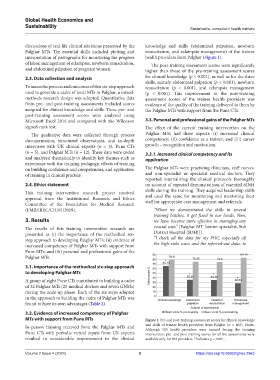
            of labor, management of eclampsia, newborn resuscitation,   The post-training assessment scores were significantly
            and abdominal palpation of pregnant women.         higher than those of the pre-training assessment scores
            2.3. Data collection and analysis                  for clinical knowledge (p < 0.001), as well as for the three
                                                               skills, namely abdominal palpation (p < 0.001), newborn
            To assess the process and outcomes of this six-step approach   resuscitation (p < 0.001), and eclampsia management
            used to generate a cadre of local MTs in Palghar, a mixed-  (p < 0.001). This improvement in the post-training
            methods research design was adopted. Quantitative data   assessment scores of the trainee health providers was
            from pre- and post-training assessments included scores   evidence of the quality of the training delivered to them by
            assigned for clinical knowledge and skills. These pre- and   the Palghar MTs with support from the Pune CTs.
            post-training assessment scores were analyzed using
            Microsoft  Excel  2016  and  compared  with  the  Wilcoxon   3.3. Personal and professional gains of the Palghar MTs
            signed-rank test.                                  The effect of the current training intervention on the
              The qualitative data were collected through process   Palghar MTs had three aspects: (i)  increased clinical
            documentation, structured observations, and in-depth   competency; (ii) confidence as a trainer; and (iii) career
            interviews with UK clinical experts (n = 3), Pune CTs   growth – recognition and motivation.
            (n = 5), and Palghar MTs (n = 12). These data were coded   3.3.1. Increased clinical competency and its
            and analyzed thematically to identify key themes such as   application
            experience with the training pedagogy, effects of training
            on building confidence and competencies, and application   The Palghar MTs were practicing clinicians, staff nurses,
            of training in clinical practice.                  and non-specialist or specialist medical doctors. They
                                                               reported internalizing the clinical protocols thoroughly
            2.4. Ethics statement                              on account of repeated demonstrations of essential MNH
            This  training  intervention  research  project  received   skills during the training. They acquired leadership skills
            approval from the Institutional Research and Ethics   and used the same for monitoring and mentoring their
            Committee of the Foundation for Medical Research   staff for appropriate case management and referrals.
            (FMR/IREC/CH/01/2019).                                “When we demonstrated the skills in several
                                                                  training batches, it got fixed in our heads. Now,
            3. Results                                            we  have  become  more  effective  in  managing  any
            The results of this training intervention research are   crucial case.” (Palghar MT [senior specialist, Sub
            presented as (i) the importance of the methodical six-  District Hospital {SDH}])
            step approach to developing Palghar MTs; (ii) evidence of      “I check all the data for my PHC, especially all
            increased competency of Palghar MTs with support from   the high-risks cases and the referred-out data, to
            Pune MTs; and (iii) personal and professional gains of the
            Palghar MTs.                                          90   *  79.31    75.45     74.5      84.19
                                                                  80
            3.1. Importance of the methodical six-step approach   70  66.13
                                                                  60
            to developing Palghar MTs                            Mean score %  50  *        *
                                                                                                      *
            A group of eight Pune CTs contributed to building a cadre   40      36.38      35.35     28.69
                                                                  30
            of 32 Palghar MTs (25 medical doctors and seven GNMs)   20
            during the scale-up phase. Each of the six steps adopted   10
            in the approach to building the cadre of Palghar MTs was   0  Clinical knowledge  Abdominal  Newborn  Eclampsia
            found to have its own advantages (Table 2).                          palpation  resuscitation  management
                                                                                  Subject of assessment
            3.2. Evidence of increased competency of Palghar           Mean score % pre-training  Mean score % post-training
            MTs with support from Pune MTs                     Figure 1. Pre and post-training assessment scores for clinical knowledge
            In-person training received from the Palghar MTs and   and skills of trainee health providers from Palghar (n = 463). Notes:
                                                               Although 505 health providers were trained during the training
            Pune CTs with periodic virtual inputs from UK experts   intervention, pre- and post-training scores for all the assessments were
            resulted in  considerable  improvement  in  the clinical   available only for 463 providers. *Indicates p < 0.001.


            Volume 2 Issue 4 (2024)                         5                        https://doi.org/10.36922/ghes.2963

