


Page 99 - GHES-2-4
P. 99
Global Health Economics and
            Sustainability
                                                                                  Sustainable, competent health trainers


            (ii)  Step 2: Training of potential master trainers with   supported by one Pune CT. In addition to providing clinical
               pre- and post-ToT assessment.                   guidance and feedback, this supportive supervision included
              The 32 selected candidates participated in the ToT to   teaching the new trainers the pedagogy for adhering to adult
            become Palghar MTs, with pre- and post-ToT assessments of   learning principles and ensuring adequate time for a reverse
            clinical knowledge and skills as well as teaching skills. Adult   demonstration of the relevant skill by each participant.
            learning  principles,  including  exhibiting  a  participatory,   The MT demonstrated a clinical skill to a group of 5 – 6
            interactive,  and  respectful  learning  approach,  providing   participants using a mannequin in a stepwise manner and
            opportunities for participants to think and learn, and ensuring   asked each participant to observe. Subsequently, each of
            active engagement and hands-on practice for participants   them was requested to demonstrate the skill to the MT,
            with explanations of step-wise management, were applied   engaging the rest of the participants in the process. The MT
            during the ToT and all subsequent training. A simulation   observed and provided feedback to each participant. This
            of various high-risk cases with complications was used for   step provided a longer time frame for the MTs to work as
            discussing step-wise case management. The pre- and post-  trainers with the mentorship of the Pune CTs.
            ToT assessments included written examinations, structured
            observations of teaching skills, and clinical demonstrations   (v)  Step 5: Regular quality assessment by the UK experts.
            with mannequins using checklists. A total of 18 participants   Due to  travel constraints  during the COVID-19
            achieved  a  composite  score  of  more  than  85%,  and  the   pandemic, structured quality assessment and feedback
            remaining 14 scored in the range of 70 – 84% in the post-ToT   sessions (n  = 3) were conducted remotely by the UK
            assessment out of the 32 Palghar MTs.              experts.  These  sessions  aided  in  ensuring  the  correct
                                                               demonstration of clinical skills and standardized
            (iii) Step 3: Staggered induction of selected candidates as   delivery of training content by the Palghar MTs. While
               MTs.                                            the Palghar MTs had the essential clinical knowledge,
              A strategic process of staggered and structured   they initially found it challenging to conduct case-based
            induction was adopted for 32 Palghar MTs for conducting   sessions, providing trainees with practice opportunities
            training for health providers from the public health system   and allowing time for reflection and learning. They
            in Palghar. Master trainers with “intermediate” scores (70   were provided with feedback and tips during the initial
            – 84%; n = 14) were paired up with those with the “highest”   rounds of teaching demonstrations to help them adapt
            scores (85% and above) (n = 18). After working with the   to this more inclusive pedagogy. Most MTs implemented
            highest-scoring trainers for at least two training batches,   the corrective steps as suggested by the UK experts and
            they were inducted as independent trainers. The Palghar
            MTs then conducted training for 505 health providers over   showed improvements in the subsequent rounds of skill
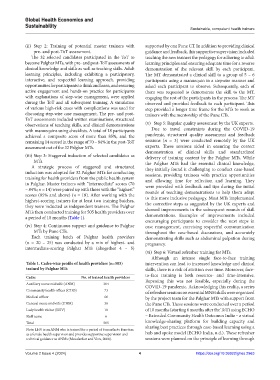
            a period of 18 months (Table 1).                   demonstrations. Examples of improvements included
                                                               encouraging participants to consider the next steps in
            (iv)  Step 4: Continuous support and guidance to Palghar   case management, exercising respectful communication
               MTs by Pune CTs.                                throughout the case-based discussions, and accurately
              Each training batch of Palghar health providers   demonstrating skills such as abdominal palpation during
            (n  =  20  –  25)  was  conducted  by  a  mix  of  highest-  and   pregnancy.
            intermediate-scoring Palghar MTs (altogether 4 – 5)
                                                               (vi) Step 6: Virtual refresher training for MTs.
                                                                 Although an intense single face-to-face training
            Table 1. Cadre‑wise profile of health providers (n=505)   intervention can lead to increased knowledge and clinical
            trained by Palghar MTs                             skills, there is a risk of attrition over time. Moreover, face-
                                                               to-face training is both resource-  and time-intensive.
            Cadre                   No. of trained health providers
                                                               Repeating  this  was  not  feasible,  especially  during  the
            Auxiliary nurse midwife (ANM)    304               COVID-19 pandemic. Acknowledging this reality, a series
            Community health officer (CHO)   73                of refresher sessions on essential MNH skills were organized
            Medical officer                  66                by the project team for the Palghar MTs with support from
            General nurse midwife (GNM)      38                the Pune CTs. These sessions were conducted over a period
            Lady health visitor (LHV)        18                of 10 months (starting 6 months after the ToT) using ECHO
            Staff nurse                       6                – Extended Community Health Outcomes India – a virtual
            Total                            505               knowledge-sharing platform for building capacity and
            Note: LHV is an ANM who is trained for a period of 6 months to function   sharing best practices through case-based learning using a
            as a female health supervisor and provides supportive supervision and   hub and spoke model (ECHO India, n.d.). These refresher
            technical guidance to ANMs (Mavalankar and Vora, 2008).  sessions were planned on the principle of learning through


            Volume 2 Issue 4 (2024)                         4                        https://doi.org/10.36922/ghes.2963

