


Page 11 - GHES-2-4
P. 11
Global Health Economics and
            Sustainability
                                                                           COVID-19 and the burden on healthcare workers


            Table 1. Systematic search strategy used for the narrative   Records identified through  Additional records identified
            review                                                    database searching  through other sources
                                                                         (n = 53)
                                                                                             (n = 5)
            SEARCH STRATEGY                                      Identification
            “impact” OR “psychological impact”
                                                                            Records after duplicates removed
            AND                                                                    (n = 50)
            “COVID-19” OR “coronavirus” OR “2019-ncov” or “sars-cov-2” or “cov-19”
            AND                                                  Screening      Records screened
            “Emergency department” OR “emergency room” OR “accident and            (n = 50)
            emergency” OR “accident & emergency” OR “a&e” OR “a & e”
            AND                                                                                  Records excluded
            “staff” OR “healthcare workers” OR “nurses” OR “medical workers”                        (n = 30)
            OR “medical practitioners” OR “medical workforce” OR “healthcare   Eligibility & Inclusion
            professionals”                                                 Studies included for full-text review
                                                                              and qualitative synthesis
            2.5. Screening procedure                                               (n = 20)
                                                               Figure 1. Search strategy flow diagram
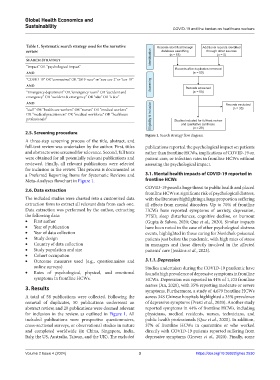
            A three-step screening process of the title, abstract, and
            full-text review was undertaken by the author. First, titles   publications reported the psychological impact on patients
            and abstracts were screened for relevance. Second, full texts   rather than frontline HCWs, implications of COVID-19 on
            were obtained for all potentially relevant publications and   patient care, or infection rates in frontline HCWs without
            reviewed. Finally,  all relevant publications were  selected   assessing the psychological impact.
            for inclusion in the review. This process is documented as
            a Preferred Reporting Items for Systematic Reviews and   3.1. Mental health impacts of COVID-19 reported in
            Meta-Analyses flowchart in Figure 1.               frontline HCWs
                                                               COVID-19 posed a huge threat to public health and placed
            2.6. Data extraction
                                                               frontline HCWs at significant risk of psychological distress,
            The included studies were charted into a customized data   with the literature highlighting a large proportion suffering
            extraction form to extract all relevant data from each one.   ill effects from mental disorders. Up to 70% of frontline
            Data extraction was performed by the author, extracting   HCWs have reported symptoms of anxiety, depression,
            the following data:                                PTSD, sleep disturbances, cognitive decline, or burnout
            •   First author                                   (Gupta & Sahoo, 2020; Que et al., 2020). Similar impacts
            •   Year of publication                            have been noted in the case of other psychological distress
            •   Year of data collection                        events, highlighted in those caring for Novichok-poisoned
            •   Study design                                   patients just before the pandemic, with high rates of stress
            •   Country of data collection                     in managers and those directly involved in the affected
            •   Study population and size                      patients’ care (Jenkins et al., 2023).
            •   Cohort occupation
            •   Outcome measures used (e.g., questionnaires and   3.1.1. Depression
               online surveys)                                 Studies undertaken during the COVID-19 pandemic have
            •   Rates of psychological, physical, and emotional   found a high prevalence of depressive symptoms in frontline
               symptoms in frontline HCWs.                     HCWs. Depression was reported in 44% of 1,103 frontline
                                                               nurses (An, 2020), with 35% reporting moderate or severe
            3. Results                                         symptoms. Furthermore, a study of 4,679 frontline HCWs
            A total of 58 publications were collected. Following the   across 348 Chinese hospitals highlighted a 35% prevalence
            removal  of  duplicates,  50 publications  underwent  an   of depressive symptoms (Presti et al., 2020). Another study
            abstract review, and 20 publications were deemed relevant   reported symptoms in 44% of frontline HCWs, including
            for inclusion in the review, as outlined in  Figure  1. All   physicians, medical residents, nurses, technicians, and
            included publications were prospective questionnaires,   public health professionals (Que et al., 2020). In addition,
            cross-sectional surveys, or observational studies in nature   37% of frontline HCWs in quarantine or who worked
            and completed worldwide (in China, Singapore, India,   directly with COVID-19 patients reported suffering from
            Italy, the US, Australia, Taiwan, and the UK). The excluded   depressive symptoms (Grover et al., 2020). Finally, some


            Volume 2 Issue 4 (2024)                         3                        https://doi.org/10.36922/ghes.2530

