


Page 170 - GHES-2-4
P. 170
Global Health Economics and
            Sustainability
                                                                                 Evaluation of mental health law in Chile


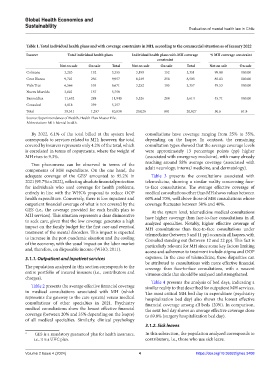
            Table 1. Total individual health plans and with coverage constraints in MH, according to the commercial situation as of January 2022
            Insurer           Total individual health plans  Individual health plans with MH coverage   % MH coverage constraint
                                                                    constraint
                           Not on sale  On sale  Total   Not on sale  On sale    Total    Not on sale  On sale
            Colmena         3,203       152      3,355     3,199       152      3,351       99.88       100.00
            Cruz Blanca     9,701       256      9,957     8,249       256      8,505       85.03       100.00
            Vida Tres       6,566       105      6,671     3,252       105      3,357       49.53       100.00
            Nueva Masvida   3,601       157      3,758
            Banmédica       11,652      288      11,940    5,326       288      5,614       45.71       100.00
            Consalud        4,818       339      5,157
            Total           39,541      1,297    40,838    20,026      801      20,827      50.6        61.8
            Source: Superintendence of Health, Health Plan Master File.
            Abbreviation: MH: Mental health.

              By 2022, 6.1% of the total billed at the system level   consultations have coverage ranging from 25% to 35%,
            corresponds to services related to MH; however, the total   depending on the Isapre. In contrast, the remaining
            covered by insurers represents only 4.2% of the total, which   consultation types showed that the average coverage levels
            is correlated in terms of copayments, where the weight of   were approximately 13 percentage points (pp) higher
            MH rises to 9.3%.                                  (associated with emergency medicine), with many already
              Two  phenomena can  be observed in  terms  of the   reaching around 58% average coverage (associated with
            components of MH expenditure. On the one hand, the   adult neurology, internal medicine, and dermatology).
            adequate coverage of the GES   amounted to 95.2% in   Table  3 presents the consultations associated with
                                     2
            2021 (95.7% in 2022), reflecting absolute financial protection   telemedicine, showing a similar reality concerning face-
            for individuals who used coverage for health problems,   to-face consultations. The average effective coverage of
            entirely in line with the WHO’s proposal to reduce OOP   medical consultations other than MH shows values between
            health expenditure. Conversely, there is low inpatient and   60% and 70%, well above those of MH consultations whose
            outpatient financial coverage of what is not covered by the   coverage fluctuates between 30% and 40%.
            GES (i.e., the coverage provided for each health plan to   At the system level, telemedicine medical consultations
            MH services). This situation represents a clear disincentive   have higher coverage than face-to-face consultations in all
            to seek care, given that the low coverage generates a high   analyzed specialties. Notably, higher effective coverage of
            impact on the family budget for the first care and eventual   MH consultations than face-to-face consultations under
            treatment of the mental disorders. This impact is expected   telemedicine (between 5 and 11 pp) occurs in all Isapres, with
            to increase in the post-pandemic situation and the cooling   Consalud standing out (between 12 and 22 pp). This fact is
            of the economy, with the usual impact on the labor market   particularly relevant for MH since some key factors limiting
            and, therefore, on disposable income (WHO, 2011).  access and adherence to treatment include stigma and OOP

            3.1.1. Outpatient and inpatient services           expenses. In the case of telemedicine, these disparities can
                                                               be attributed to consultations with more effective financial
            The population analyzed in this section corresponds to the   coverage than face-to-face consultations, with a nascent
            entire portfolio of insured insurers (i.e., contributors and   virtuous circle that should be analyzed and strengthened.
            charges).
                                                                 Table 4 presents the analysis of bed days, indicating a
              Table 2 presents the average effective financial coverage   similar reality to that described for outpatient MH services.
            in medical consultations associated with MH (which   The most critical MH bed day in expenditure (psychiatry
            represents the gateway to the care system) versus medical   hospitalization bed day) also shows the lowest effective
            consultations of  other specialties  in  2021. Psychiatry   financial coverage among all beds (20%). In comparison,
            medical consultations show the lowest effective financial   the next bed day shows an average effective coverage close
            coverage (between 20% and 35% depending on the Isapre)   to 69.8% (surgery hospitalization bed day).
            of all medical specialties. Similarly, clinical psychology
                                                               3.1.2. Sick leaves
            2     GES is a mandatory guaranteed plan for health insurance,   In this subsection, the population analyzed corresponds to
               i.e., it is a UHC plan.                         contributors, i.e., those who use sick leave.


            Volume 2 Issue 4 (2024)                         4                        https://doi.org/10.36922/ghes.3408

