


Page 91 - GHES-2-4
P. 91
Global Health Economics and
            Sustainability
                                                                       Nurse perceptions of quality measured by SERVPERF


               interactions and are protected from risk or danger. It   consistency. In this study, an overall Cronbach’s alpha value
               gauges whether hospital practices help prevent errors,   of 0.72 was obtained, indicating satisfactory reliability of
               transmission of infections, and other risks to patient   the questionnaire.
               well-being.
            •   Empathy  encompasses   caring,  individualized  2.4.3. Dimension analysis
               attention provided to patients. It assesses whether staff   The five dimensions of service quality (tangibility,
               pays attention, communicates well, and understands   reliability, responsiveness, empathy, and assurance) were
               specific patient needs and preferences.         analyzed separately to determine nurses’ perceptions of
              The Cronbach’s alpha test was used to measure the   each dimension. Mean scores and standard deviations
            reliability of the questionnaire, while Pearson’s coefficient   were calculated for each dimension. This analysis helped
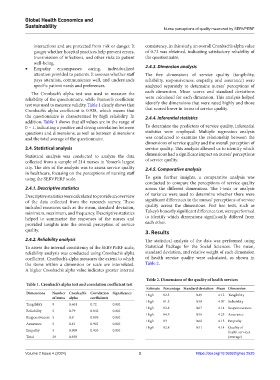
            test was used to measure validity. Table 1 clearly shows that   identify the dimensions that were rated highly and those
            Cronbach’s alpha coefficient is 0.938, which means that   that scored lower in terms of service quality.
            the  questionnaire  is  characterized  by  high  reliability.  In   2.4.4. Inferential statistics
            addition, Table 1 shows that all values are in the range of
            0 – 1, indicating a positive and strong correlation between   To determine the predictors of service quality, inferential
            questions and dimensions, as well as between dimensions   statistics were employed. Multiple regression analysis
            and the total average of the questionnaire.        was conducted to examine the relationship between the
                                                               dimensions of service quality and the overall perception of
            2.4. Statistical analysis                          service quality. This analysis allowed us to identify which

            Statistical  analysis  was  conducted  to  analyze  the  data   dimensions had a significant impact on nurses’ perceptions
            collected from a sample of 214 nurses in Yemen’s largest   of service quality.
            city. The aim of the analysis was to assess service quality   2.4.5. Comparative analysis
            in healthcare, focusing on the perceptions of nursing staff
            using the SERVPERF scale.                          To gain further insights, a comparative analysis was
                                                               conducted to compare the perceptions of service quality
            2.4.1. Descriptive statistics                      across the different dimensions. The  t-tests or analysis
            Descriptive statistics were calculated to provide an overview   of variance were used to determine whether there were
            of the data collected from the research survey. These   significant differences in the nurses’ perceptions of service
            included measures such as the mean, standard deviation,   quality across the dimensions.  Post hoc tests, such as
            minimum, maximum, and frequency. Descriptive statistics   Tukey’s honestly significant difference test, were performed
            helped to  summarize  the  responses  of  the  nurses  and   to  identify which dimensions significantly  differed from
            provided insights into the overall perception of service   each other.
            quality.                                           3. Results

            2.4.2. Reliability analysis                        The statistical analysis of the data was performed using
            To assess the internal consistency of the SERVPERF scale,   Statistical Package for the Social Sciences. The mean,
            reliability analysis was conducted using Cronbach’s alpha   standard deviation, and relative weight of each dimension
            coefficient. Cronbach’s alpha measures the extent to which   of health service quality were calculated, as shown in
            the items within a dimension or scale are interrelated.   Table 2.
            A higher Cronbach’s alpha value indicates greater internal

                                                               Table 2. Dimensions of the quality of health services
            Table 1. Cronbach’s alpha test and correlation coefficient test
                                                               Estimate Percentage Standard deviation Mean Dimension
            Dimensions  Number  Cronbach’s  Correlation  Significance  High  82.3   0.49      4.12 Tangibility
                       of items  alpha  coefficients
            Tangibility  9    0.661    0.72      0.001         High   81.3          0.58      4.07 Reliability
                                                               High   82.8          0.67      4.14 Responsiveness
            Reliability  5    0.79     0.843     0.001
                                                               High   84.5          0.56      4.23 Assurance
            Responsiveness 5  0.9      0.895     0.001
                                                               High   83            0.68      4.15 Empathy
            Assurance  5      0.81     0.901     0.001
                                                               High   82.8          0.51      4.14 Quality of
            Empathy    5      0.908    0.933     0.001                                            health services
            Total      29     0.938                                                               (average)


            Volume 2 Issue 4 (2024)                         3                        https://doi.org/10.36922/ghes.2525

