


Page 86 - GHES-2-4
P. 86
Global Health Economics and
            Sustainability
                                                                          NHIS: Acceptability and preferred benefit package


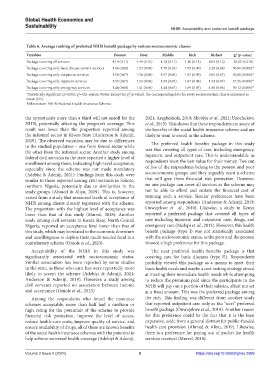
            Table 6. Average ranking of preferred NHIS benefit package by various socioeconomic classes
            Variables                            Poorest     Poor     Middle     Rich      Richest  χ  (p‑value)
                                                                                                     2
            Package covering all services        4.19 (0.11)  4.49 (0.10)  4.10 (0.11)  4.10 (0.11)  4.02 (0.12)  20.22 (0.210)
            Package covering only basic disease control services  1.66 (0.08)  1.57 (0.08)  1.78 (0.10)  1.95 (0.09)  2.20 (0.08)  50.66 (0.000)*
            Package covering only outpatient services  1.54 (0.07)  1.56 (0.08)  1.57 (0.09)  1.87 (0.09)  2.06 (0.07)  50.88 (0.000)*
            Package covering only inpatient services   1.53 (0.07)  1.53 (0.08)  1.50 (0.07)  1,84 (0.08)  1.94 (0.07)  37.26 (0.000)*
            Package covering only emergency services  1.44 (0.06)  1.41 (0.06)  1.44 (0.07)  1.69 (0.07)  1.88 (0.06)  39.12 (0.000)*
            *Statistically significant (p<0.05); χ =Chi-square. Notes: Except for χ  (p-value), the corresponding data for every socioeconomic class is expressed as
                                                        2
                                  2
            mean (SD).
            Abbreviation: NHIS: National Health Insurance Scheme.
            the opportunity more than a third will not enroll for the   2021; Aregbeshola, 2018; Shobiye et al., 2021; Uzochukwu
            NHIS, potentially affecting the program’s coverage. This   et al., 2015). This shows that these respondents are aware of
            result  was  lower  than  the  proportion  reported  among   the benefits of the social health insurance scheme and are
            the informal sector in Rivers State (Anderson & Adeniji,   likely to want to enroll in the scheme.
            2019). The observed variation may be due to differences   The preferred health benefits package in this study
            in the studied population – one from formal sector while
            the other from the informal sector. Another study among   was that covering all types of care, including emergency,
            federal civil servants in the state reported a higher level of   inpatient, and outpatient care. This is understandable as
            enrollment among them, indicating high-level acceptance,   respondents want the best value for their money. Two out
            especially since the scheme was not made mandatory   of five of the respondents belong to the poorest and poor
            (Adebiyi & Adeniji, 2021). Findings from this study were   socioeconomic groups and they arguably want a scheme
            similar to those reported among civil servants in Sokoto,   that  will  give  them  financial  risk  protection.  However,
            northern Nigeria, potentially due to similarities in the   no one package can cover all services as the scheme may
            study groups (Ahmed & Aliyu, 2019). This is, however,   not be able to afford and sustain the financial cost of
            varied from a study that measured levels of acceptance of   running  such  a  service.  Similar  preferences  have  been
            NHIS among clients already registered with the scheme.   reported among respondents (Anderson & Adeniji, 2019;
            The proportion with the highest level of acceptance was   Onwujekwe  et   al., 2010). Likewise, a study in Kenya
            lower than that of this study (Marvel, 2018). Another   reported a  preferred  package  that  covered all types of
            study among civil servants in Kwara State, North Central   care  including  inpatient  and  outpatient  care,  drugs,  and
            Nigeria, reported an acceptance level lower than that of   emergency care (Mulupi et  al., 2013). However, this health
            this study, which may be related to the economic downturn   benefit package (type  I) was not statistically associated
            and unwillingness to deplete their much-needed fund in a   with the socioeconomic status, as the poor and the poorest
            contributory scheme (Omole et al., 2023).          showed a high preference for this package.
              Acceptability  of  the  NHIS  in  this  study  was   The next preferred health benefits package is that
            significantly associated with socioeconomic status.   covering care for basic diseases (type  II). Respondents
            Similar association has been reported by some studies   probably  viewed  this  package  as  a  means  to  meet  their
            in the state, as those who earn less were reportedly more   basic health needs and maybe a cost-cutting strategy aimed
            likely to accept the scheme (Adebiyi & Adeniji, 2021;   at meeting their immediate health needs while attempting
            Anderson  &  Adeniji,  2019).  However,  a  study  among   to reduce the premium paid since the participants in the
            civil servants reported no association between income   NHIS will pay out a portion of their salaries, albeit not set
            and acceptance (Omole et al., 2023)                at a fixed amount. This was the preferred package among
              Among the respondents who found the insurance    the rich. This finding was different from another study
            schemes  acceptable,  more  than half  had  a medium  or   that reported outpatient care only as the “next” preferred
            high rating for the potentials of the scheme to provide   benefit package (Onwujekwe et al., 2010). Another reason
            financial risk protection, improve the level of access,   for this preference could be the fact that it is the least
            reduce health-care costs, improve quality of service, and   expensive, aside from a general distrust for public-funded
            ensure availability of drugs, all of these are known benefits   health-care provision (Ahmed & Aliyu, 2019). Likewise,
            of the social health insurance schemes with the potential to   there is a preference for paying out of pocket for health
            help achieve universal health coverage (Adebiyi & Adeniji,   services received (Marvel, 2018).


            Volume 2 Issue 4 (2024)                         8                        https://doi.org/10.36922/ghes.2909

