


Page 84 - GHES-2-4
P. 84
Global Health Economics and
            Sustainability
                                                                          NHIS: Acceptability and preferred benefit package


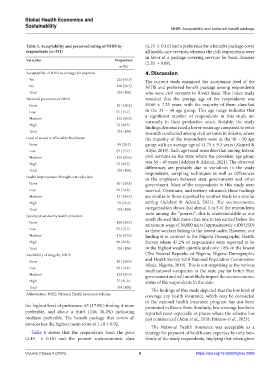
            Table 3. Acceptability and perceived rating of NHIS by   (4.19  ±  0.11) had a preference for a benefits package cover
            respondents (n=351)                                all health-care services, whereas the rich respondents were
                                                               in favor of a package covering services for basic diseases
            Variables                             Proportion   (2.20  ± 0.08).
                                                    n (%)
            Acceptability of NHIS as strategy for payment      4. Discussion
             Yes                                   223 (63.5)  The current study examined the acceptance level of the
             No                                    128 (36.5)  NHIS and preferred benefit package among respondents
             Total                                 351 (100)   who were civil servants in Rivers State. This index study
            Financial protection of NHIS                       revealed that the average age of the respondents was
             None                                  101 (28.8)  40.60  ± 7.33  years, with the majority of them classified
             Low                                    55 (15.7)  in the  31 –  40 age group. This age  range indicates that
             Medium                                123 (35.0)  a significant number of respondents in this study are
                                                               currently in their productive years. Notably, the study
             High                                   72 (20.5)  findings demonstrated a lower mean age compared to prior
             Total                                 351 (100)   research conducted among civil servants in Sokoto, where
            Level of access to affordable Healthcare           the majority of the respondents were in the 40 – 50 age
             None                                  99 (28.2)   group with an average age of 41.75 ± 9.3 years (Ahmed &
             Low                                    55 (15.7)  Aliyu, 2019). Such age trend resembles that among federal
             Medium                                125 (35.6)  civil servants in the state where the prevalent age group
             High                                   72 (20.5)  was 36 – 45 years (Adebiyi & Adeniji, 2021). The observed
                                                               differences are probably due to variations in the study
             Total                                 351 (100)   respondents, sampling techniques as well as differences
            Health improvement through cost reduction          in the employers between state governments and other
             None                                  101 (28.8)  government. Most of the respondents in this study were
             Low                                    50 (14.2)  married, Christians, and tertiary-educated; these findings
             Medium                                121 (34.5)  are similar to those reported by another study in a similar
             High                                    79 (22.5)  setting (Adebiyi & Adeniji, 2021). The socioeconomic
             Total                                 351 (100)   categorization shows that almost 1 in 5 of the respondents
            Quality of service by health providers             were among the “poorest”; this is understandable as our
                                                               result showed that more than one in ten earned below the
             None                                  100 (28.5)  minimum wage of 30,000 naira (approximately <100 USD)
             Low                                    55 (15.7)  as these workers belong to the lowest cadre. However, our
             Medium                                116 (33.0)  finding is in contrast to the Nigeria Demographic Health
             High                                   80 (22.8)  Survey where 47.2% of respondents were reported to be
             Total                                 351 (100)   in the highest wealth quintile and only 1.8% in the lowest
            Availability of drugs by NHIS                      (The Federal Republic of Nigeria, Nigeria Demographic
                                                               and Health Survey 2018 National Population Commission
             None                                  101 (28.8)
             Low                                    50 (14.2)  Abuja, Nigeria, 2019). This is not surprising as the various
                                                               multinational companies in the state pay far better than
             Medium                                124 (35.3)  government and will most likely impact the socioeconomic
             High                                   77 (21.9)  status of the respondents in the state.
             Total                                 351 (100)
                                                                 The findings of this study depicted that the low level of
            Abbreviation: NHIS: National Health Insurance Scheme.  coverage any health insurance, which may be connected
                                                               to the national health insurance program has just been
            the highest level of preference, 63 (17.9%) finding it more   promoted in Rivers State. Similarly, low coverage has been
            preferable, and about a third (106; 30.2%) indicating   reported most especially in places where the scheme has
            medium preferable. The benefit package that covers all   just commenced (Amu et al., 2018; Erinoso et al., 2023).
            services has the highest mean score of 4.18 ± 0.92.
                                                                 The National Health Insurance was acceptable as a
              Table  6 shows that the respondents from the poor   strategy for payment of health-care expenses by only two-
            (4.49   ± 0.10) and the poorest socioeconomic class   thirds of the study respondents, implying that when given


            Volume 2 Issue 4 (2024)                         6                        https://doi.org/10.36922/ghes.2909

