


Page 190 - GHES-3-2
P. 190
Global Health Economics and
            Sustainability
                                                                         Post-partum modern contraceptive use in Pakistan


            in 2017 – 2018. The PDHS Program is a 5-year initiative   information communication and technology indicators to
            designed to help organizations gather and analyze data for   assess the effect of technology. The detailed definition and
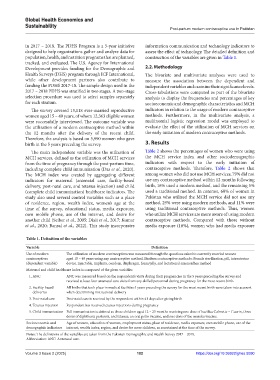
            population, health, and nutrition programs that are planned,   construction of the variables are given in Table 1.
            tracked, and evaluated. The U.S. Agency for International
            Development provides funding for the Demographic and   2.2. Methodology
            Health Surveys (DHS) program through ICF International,   The bivariate and multivariate analyses were used to
            while other development partners also contribute to   measure  the  association between the  dependent and
            funding the PDHS 2017-18. The sample design used in the   independent variables and examine their significance levels.
            2017 – 2018 PDHS was stratified in two stages. A two-stage   Cross-tabulations were computed as part of the bivariate
            selection procedure was used to select samples separately   analysis to display the frequencies and percentages of key
            for each stratum.                                  socioeconomic and demographic characteristics and MCH
              The survey covered 13,118 ever-married reproductive   indicators in relation to the usage of modern contraceptive
            women aged 15 – 49 years, of whom 12,363 eligible women   methods. Furthermore, in the multivariate analysis, a
            were successfully interviewed. The outcome variable was   multinomial logistic regression model was employed to
            the utilization of a modern contraceptive method within   evaluate the effect of the utilization of MCH services on
            the 12  months after the delivery of the recent child.   the early initiation of modern contraceptive methods.
            Therefore, the analysis is based on 5,990 women who gave
            birth in the 5 years preceding the survey.         3. Results
              The main independent variable was the utilization of   Table 2 shows the percentages of women who were using
            MCH services, defined as the utilization of MCH services   the MCH service index and other sociodemographic
            from the time of pregnancy through the post-partum time,   indicators with respect to the early initiation of
            including complete child immunization (Das et al., 2020).   contraceptive methods. Therefore,  Table 2 shows that
            The  MCH  index  was  created  by  aggregating  different   among women who did not use MCH services, 79% did not
            indicators for maternal (antenatal care, facility-based   use any contraceptive method within 12 months following
            delivery, post-natal care, and tetanus injection) and child   birth, 16% used a modern method, and the remaining 5%
            (complete child immunization) healthcare indicators. The   used a traditional method. In contrast, 60% of women in
            study also used several control variables such as a place   Pakistan who utilized the MCH service did not use any
            of residence, region, wealth index, women’s age at the   method, 29% were using modern methods, and 11% were
            time of the survey, educational status, media exposure,   using traditional contraceptive methods. Thus, women
            own mobile phone, use of the internet, and desire for   who utilize MCH services are more aware of using modern
            another child (Seiber et al., 2005; Dixit et al., 2017; Kumar   contraceptive methods. Compared with those without
            et al., 2020; Bansal et al., 2022). This study incorporates   media exposure (18%), women who had media exposure


            Table 1. Definition of the variables
            Variable                                             Definition
            Use of modern    The utilization of modern contraceptives was measured through the questions asked to currently married women
            contraceptives   aged 15 – 49 years using any contraceptive method. Modern contraceptive methods: Female sterilization, pill, intrauterine
            (dependent variable)  device, injectable, implants, condom, diaphragm, foam/jelly, and lactational amenorrhea method
            Maternal and child healthcare index is composed of the given variables
             1. ANC          ANC was measured based on the respondent’s visits during their pregnancies in the 5 years preceding the survey and
                             received at least four antenatal care visits from any skilled personnel during pregnancy for the most recent birth
             2.  Facility-based   All births that took place in medical facilities 5 years preceding the survey for the most recent birth were taken into account
               deliveries    when determining institutional delivery
             3. Post-natal care  Post-natal care is received by the respondent within 41 days after giving birth
             4. Tetanus injection  Respondent has received tetanus injections during pregnancy
             5. Child immunization Full immunization is defined as those children aged 12 – 23 months receiving one dose of bacillus Calmette – Guerin, three
                             doses of diphtheria pertussis, and tetanus, an oral polio vaccine, and one dose of the measles vaccine.
            Socioeconomic and   Age of women, education of women, employment status, place of residence, media exposure, own mobile phone, use of the
            demographic indicators  internet, wealth index, region, and desire for more children, as ascertained at the time of the survey.
            Notes: The definitions of the variables are taken from the Pakistan Demographic and Health Survey 2017 – 2018.
            Abbreviation: ANC: Antenatal care.


            Volume 3 Issue 2 (2025)                        182                       https://doi.org/10.36922/ghes.5090

