


Page 192 - GHES-3-2
P. 192
Global Health Economics and
            Sustainability
                                                                         Post-partum modern contraceptive use in Pakistan


            Table 3. Results of contraceptive methods by using the   Table 3. (Continued)
            multinomial logistic technique
                                                               Use of contraceptives  RRR  SE  z  p>z  95% CI
            Use of contraceptives  RRR  SE  z  p>z  95% CI      Own mobile        1.03  0.08  0.41  0.69  0.89  1.20
            Non-users of contraceptive methods (reference category=0)  Use internet  0.82  0.09  −1.73  0.08  0.66  1.03
            Traditional contraceptive methods=1                 Telephone         0.66  0.08  −3.61  0.00  0.53  0.83
             MCH               1.41  0.17  2.84  0.00  1.11  1.78  Residence      0.95  0.07  −0.74  0.46  0.81  1.10
             Wanted child later  1.71  0.22  4.11  0.00  1.32  2.20  Region (Ref: Punjab)
            Wealth index (Ref: poorest)                         Sindh             1.01  0.11  0.12  0.91  0.82  1.24
             Poorer            1.95  0.40  3.27  0.00  1.31  2.92  Khyber Pakhtunkhwa  1.34  0.14  2.81  0.01  1.09  1.65
             Middle            3.08  0.64  5.40  0.00  2.05  4.64  Balochistan    0.57  0.08  −3.81  0.00  0.43  0.76
             Richer            3.42  0.76  5.52  0.00  2.21  5.28  Others         0.95  0.09  −0.55  0.59  0.80  1.14
             Richest           4.16  1.00  5.94  0.00  2.60  6.67  Respondent age (Ref: 15 – 19)
             Media             1.24  0.14  1.93  0.05  1.00  1.55  20 – 24        1.21  0.23  0.97  0.33  0.83  1.75
             Own mobile        0.87  0.10  −1.20  0.23  0.70  1.09  25 – 29       1.59  0.30  2.47  0.01  1.10  2.29
             Use internet      0.96  0.15  −0.26  0.79  0.71  1.30  30 – 34       2.08  0.39  3.86  0.00  1.43  3.02
             Telephone         0.61  0.10  −2.97  0.00  0.44  0.85  35 – 39       1.87  0.37  3.14  0.00  1.27  2.76
             Residence         0.72  0.08  −3.04  0.00  0.58  0.89  40 – 44       2.63  0.63  4.01  0.00  1.64  4.22
            Region (Ref: Punjab)                                45 – 49           1.38  0.58  0.77  0.44  0.61  3.14
             Sindh             0.66  0.10  −2.64  0.01  0.48  0.90  Respondent education (Ref: none)
             Khyber Pakhtunkhwa  0.86  0.13  −0.96  0.34  0.64  1.17  Primary     1.21  0.13  1.81  0.07  0.98  1.49
             Balochistan       0.48  0.10  −3.38  0.00  0.31  0.73  Secondary     1.35  0.13  2.99  0.00  1.11  1.63
             Others            1.00  0.12  0.04  0.97  0.79  1.28  Higher         1.53  0.18  3.50  0.00  1.21  1.94
            Respondent age (Ref: 15 – 19)                       Employment status  1.28  0.13  2.35  0.02  1.04  1.57
             20 – 24           1.00  0.27  −0.01  0.99  0.58  1.71  Constant      0.04  0.01  −11.55  0.00  0.02  0.07
             25 – 29           1.30  0.35  0.98  0.33  0.77  2.19  Abbreviations: RRR: Relative risk ratio; CI: Confidence interval,
             30 – 34           1.79  0.48  2.17  0.03  1.06  3.04  MCH: Maternal and child healthcare.
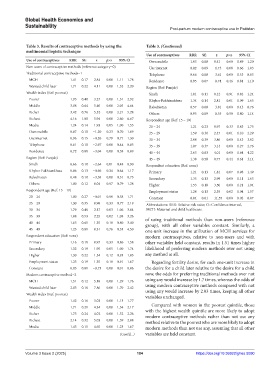
             35 – 39           1.88  0.53  2.25  0.02  1.08  3.26  of using traditional methods than non-users (reference
             40 – 44           1.65  0.61  1.35  0.18  0.80  3.40  group), with all other variables constant. Similarly, a
             45 – 49           1.23  0.81  0.31  0.76  0.33  4.50  one-unit increase in the utilization of MCH services for
            Respondent education (Ref: none)                   modern contraceptives, relative to non-users and with
             Primary           1.16  0.18  0.97  0.33  0.86  1.58  other variables held constant, results in 1.51 times higher
             Secondary         1.32  0.19  1.95  0.05  1.00  1.74  likelihood of preferring modern methods over not using
             Higher            1.30  0.22  1.54  0.12  0.93  1.83  any method at all.
             Employment status  1.23  0.19  1.35  0.18  0.91  1.67  Regarding fertility desire, for each one-unit increase in
             Constant          0.03  0.01  −8.73  0.00  0.01  0.06  the desire for a child later relative to the desire for a child
            Modern contraceptive method=2                      now, the odds for preferring traditional methods over not
             MCH               1.51  0.12  5.18  0.00  1.29  1.76  using any would increase by 1.7 times, whereas the odds of
             Wanted child later  2.03  0.18  7.86  0.00  1.70  2.42  using modern contraceptive methods compared with not
            Wealth index (Ref: poorest)                        using any would increase by 2.03 times, keeping all other
                                                               variables unchanged.
             Poorer            1.42  0.16  3.03  0.00  1.13  1.77
             Middle            1.71  0.21  4.34  0.00  1.34  2.17  Compared with women in the poorest quintile, those
             Richer            1.73  0.24  4.02  0.00  1.32  2.26  with the highest wealth quintile are more likely to adopt
                                                               modern contraceptive methods rather than not use any
             Richest           2.14  0.32  5.03  0.00  1.59  2.88
                                                               method relative to the poorest who are more likely to adopt
             Media             1.43  0.11  4.65  0.00  1.23  1.67  modern methods than not use any, assuming that all other
                                                    (Cont’d...)  variables are held constant.


            Volume 3 Issue 2 (2025)                        184                       https://doi.org/10.36922/ghes.5090

