


Page 191 - GHES-3-2
P. 191
Global Health Economics and
            Sustainability
                                                                         Post-partum modern contraceptive use in Pakistan


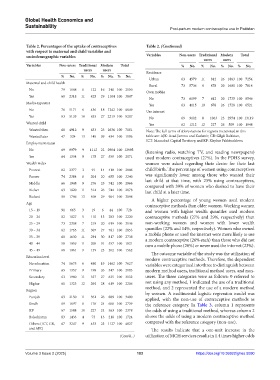
            Table 2. Percentages of the uptake of contraceptives   Table 2. (Continued)
            with respect to maternal and child variables and
            sociodemographic variables                         Variables     Non‑users  Traditional  Modern   Total
                                                                                        users   users
            Variables     Non‑users  Traditional  Modern   Total              %   No.  %  No.  %  No.  %  No.
                                     users   users
                                                               Residence
                           %   No.  %  No.  %  No.  %  No.
                                                                Urban         63  4579  11  812  26 1863 100 7254
            Maternal and child health
                                                                Rural         73  5736  6  478  20 1600 100 7814
             No            79  1688  6  122  16  340 100 2150
                                                               Own mobile
             Yes           60  2318  11  425  29 1104 100 3847
                                                                No            73  6199  7  612  20 1735 100 8546
            Media exposure
                                                                Yes           63  4115  10  678  26 1728 100 6521
             No            76  5171  6  436  18 1242 100 6849  Use internet
             Yes           63  5135  10  853  27 2219 100 8207  No            69  9102  8  1063  23 2954 100 13119
            Wanted child                                        Yes           62  1212  12  227  26  509 100 1948
             Wanted then   68  4912  9  633  23 1636 100 7181  Note: The full terms of abbreviations for regions mentioned in this
             Wanted later  47  524  13  148  39  434 100 1106  table are: AJK: Azad Jammu and Kashmir, GB: Gilgit Baltistan,
                                                               ICT: Islamabad Capital Territory, and KP: Khyber Pakhtunkhwa.
            Employment status
             No            69  8979  9  1112  22 2904 100 12995  (listening radio, watching TV, and reading newspapers)
             Yes           64  1334  9  178  27  559 100 2071  used modern contraceptives (27%). In the PDHS survey,
            Wealth index                                       women were asked regarding their desire for their last
             Poorest       82  2377  3  91  14  418 100 2886   child/birth. The percentage of women using contraceptives
             Poorer        74  2384  6  201  20  655 100 3240  was  significantly  lower  among  those  who  wanted  their
             Middle        66  1948  9  276  25  742 100 2966  last child at that time, with 23% using contraceptives,
                                                               compared with 39% of women who desired to have their
             Richer        63  1820  11  314  26  744 100 2878  last child at a later time.
             Richest       58  1786  13  408  29  904 100 3098
                                                                 A higher percentage of young women used modern
            Age
                                                               contraceptive methods than older women. Working women
             15 – 19       91  665  3   19  6   44  100  728   and  women  with  higher  wealth  quantiles  used  modern
             20 – 24       82  1827  5  110  13  283 100 2220  contraceptive methods (27% and 29%, respectively) than
             25 – 29       73  2308  7  219  20  619 100 3146  non-working women and women with lower wealth
             30 – 34       62  1765  11  307  27  781 100 2853  quantiles (22% and 14%, respectively). Women who owned
                                                               a mobile phone or used the internet were more likely to use
             35 – 39       60  1630  11  291  30  817 100 2738  a modern contraceptive (26% each) than those who did not
             40 – 44       58  1059  11  205  31  557 100 1821  own a mobile phone (20%) or never used the internet (23%).
             45 – 49       68  1061  9  139  23  362 100 1562
            Education level                                      The outcome variable of the study was the utilization of
                                                               modern contraceptive methods. Therefore, the dependent
             No education  74  5675  6  490  19 1462 100 7627  variables were categorized into three to distinguish between
             Primary       65  1357  9  199  26  547 100 2103  modern method users, traditional method users, and non-
             Secondary     63  1960  11  337  27  835 100 3132  users. The three categories were as follows: 0 referred to
             Higher        60  1323  12  264  28  619 100 2206  not using any method, 1 indicated the use of a traditional
                                                               method, and 2 represented the use of a modern method
            Region
                                                               by women. A multinomial logistic regression model was
             Punjab        63  2150  11  361  26  889 100 3400  applied,  with  the  non-use  of  contraceptive  methods  as
             Sindh         69  1897  6  176  24  666 100 2739  the reference category. In  Table 3, column 1 represents
             KP            67  1588  10  227  24  563 100 2378  the odds of using a traditional method, whereas column 2
             Balochistan   83  1433  4  73  13  218 100 1724   shows the odds of using a modern contraceptive method
             Others (ICT, GB,   67  3247  9  453  23 1127 100 4827  compared with the reference category (non-use).
             and AJK)                                            The results indicate that a one-unit increase in the
                                                    (Cont’d...)  utilization of MCH services results in 1.4 times higher odds


            Volume 3 Issue 2 (2025)                        183                       https://doi.org/10.36922/ghes.5090

