


Page 50 - GHES-3-2
P. 50
Global Health Economics and
            Sustainability
                                                                                 Aging and health facilities in Indian cities


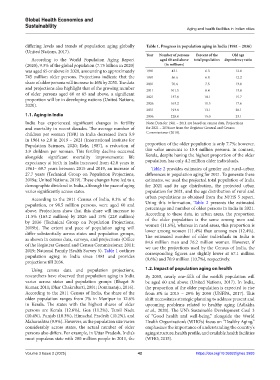
            differing levels and trends of population aging globally   Table 1. Progress in population aging in India (1981 – 2036)
            (United Nations, 2017).
                                                               Year  Number of persons   Percent of the   Old age
              According  to the World  Population Aging Report       aged 60 and above   total population  dependency ratio
            (2020), 9.3% of the global population (7.75 billion in 2020)   (in millions)
            was aged 65 or above in 2020, amounting to approximately   1981  43.1       6.3          12.0
            745 million older persons. Projections indicate that the   1991  56.6       6.8          12.2
            share of older persons will increase to 16% by 2050. The data   2001  76.6  7.5          13.0
            and projections also highlight that of the growing number   2011  101.5     8.4          13.8
            of older persons aged 60 or 65 and above, a significant
            proportion will be in developing nations (United Nations,   2021  137.9     10.1         15.7
            2020).                                             2026       163.2         11.5         17.6
                                                               2031       193.8         13.1         20.1
            1.1. Aging in India                                2036       228.0         15.0         23.1
            India has experienced significant changes in fertility   Note: Data for 1981 – 2011 are based on census data. Projections
            and mortality in recent decades. The average number of   for 2021 – 2036 are from the Registrar General and Census
            children  per  woman  (TFR)  in  India decreased  from  5.9   Commissioner (2019).
            in 1961 to 2.0 in 2019 – 2021 (International Institute for
            Population Sciences, 2020; Rele, 1987), a reduction of   proportion of the older population is only 7.7%; however,
            3.9 children per woman. This fertility decline occurred   this  value  amounts  to  15.4 million  persons.  In  contrast,
            alongside significant mortality improvements: life   Kerala, despite having the highest proportion of the older
            expectancy at birth in India increased from 42.0 years in   population, has only 4.2 million older individuals.
            1961– 69.7 years between 2015 and 2019, an increase of   Table 2 provides estimates of gender and rural–urban
            27.7  years (Technical Group on Population Projections,   differences in population aging for 2021. To generate these
            2019a; United Nations, 2019). These changes have led to a   estimates, we used the projected total population of India
            demographic dividend in India, although the pace of aging   for 2021 and its age distribution, the projected urban
            varies significantly across states.                population for 2021, and the age distribution of rural and
              According to the 2011 Census of India, 8.3% of the   urban populations as obtained from the NFHS 5 report.
            population, or 98.5 million persons, were aged 60 and   Using this information,  Table 2 presents the estimated
            above.  Projections show that this  share will  increase  to   percentage and number of older persons in India in 2021.
            11.5% (163.2 million) by 2026 and 15% (228 million)   According to these data, in urban areas, the proportion
            by 2036 (Technical Group on Population Projections,   of the  older population is  the same  among men and
            2019b). The extent and pace of population aging will   women (11.6%), whereas in rural areas, this proportion is
            differ substantially across states and population groups,   lower among women (11.4%) than among men (12.4%).
                                                               The estimated number of older individuals in India is
            as shown in census data, surveys, and projections (Office   84.6 million men and 76.2 million women. However, if
            of the Registrar General and Census Commissioner, 2011;   we use the projections used by the Census of India, the
            2019; National Family Health Survey 5). Table 1 outlines   corresponding  figures are slightly lower at 67.1 million
            population aging in India since 1981 and provides   (9.6%) and 70.9 million (10.7%), respectively.
            projections till 2036.
              Using census data and population projections,    1.2. Impact of population aging on health
            researchers have observed that population aging in India   By 2050, nearly one-fifth of the world’s population will
            varies across states and population groups (Bhagat &   be  aged 60 and above (United  Nations, 2017).  In India,
            Kumar, 2011; Dhar Chakrabarti, 2001; Dommaraju, 2016).   the proportion of the older population is expected to rise
            According to the 2011 Census of India, the share of the   from 8% in 2015 – 20% by 2050 (UNFPA, 2017). This
            older population ranges from 7% in Manipur to 12.6%   shift necessitates strategic planning to address present and
            in Kerala. The states with the highest shares of older   upcoming problems related to healthy aging (Adlakha
            persons are Kerala (12.6%), Goa (11.2%), Tamil Nadu   et al., 2020). The UN’s Sustainable Development Goal 3
            (10.4%), Punjab (10.3%), Himachal Pradesh (10.2%), and   of  “Good  health  and  well-being,”  alongside  the  World
            Maharashtra (9.9%). However, as the population size varies   Health Organization’s (WHO’s) focus on “Healthy Aging,”
            considerably across states, the actual number of older   emphasizes the importance of understanding the country’s
            persons also differs. For example, in Uttar Pradesh, India’s   aging structure, health profile, and available health facilities
            most populous state with 200 million people in 2011, the   (WHO, 2015).


            Volume 3 Issue 2 (2025)                         42                       https://doi.org/10.36922/ghes.3993

