


Page 53 - GHES-3-2
P. 53
Global Health Economics and
            Sustainability
                                                                                 Aging and health facilities in Indian cities


                         A                                     B


                                             C


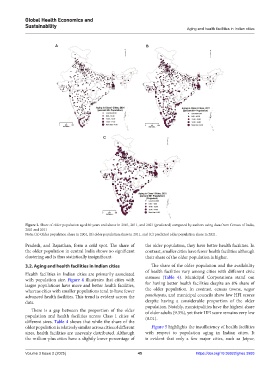
            Figure 2. Share of older population aged 60 years and above in 2001, 2011, and 2021 (predicted) computed by authors using data from Census of India,
            2001 and 2011
            Note: (A) Older population share in 2001, (B) older population share in 2011, and (C) predicted older population share in 2021.
            Pradesh,  and  Rajasthan,  form  a  cold  spot.  The  share  of   the older population, they have better health facilities. In
            the older population in central India shows no significant   contrast, smaller cities have fewer health facilities although
            clustering and is thus statistically insignificant.  their share of the older population is higher.

            3.2. Aging and health facilities in Indian cities    The share of the older population and the availability
                                                               of health facilities vary among cities with different civic
            Health facilities in Indian cities are primarily associated   statuses  (Table  4).  Municipal  Corporations stand  out
            with population size.  Figure  4 illustrates that cities with
            larger populations have more and better health facilities,   for having better health facilities despite an 8% share of
            whereas cities with smaller populations tend to have fewer   the older population. In contrast, census towns,  nagar
            advanced health facilities. This trend is evident across the   panchayats, and municipal councils show low HFI scores
            data.                                              despite having a considerable proportion of the older
                                                               population. Notably, municipalities have the highest share
              There is a gap between the proportion of the older   of older adults (9.3%), yet their HFI score remains very low
            population and  health  facilities across  Class  I cities of   (0.01).
            different sizes. Table 4 shows that while the share of the
            older population is relatively similar across cities of different   Figure 5 highlights the insufficiency of health facilities
            sizes, health facilities are unevenly distributed. Although   with respect to population aging in Indian cities. It
            the million-plus cities have a slightly lower percentage of   is evident that only a few major cities, such as Jaipur,


            Volume 3 Issue 2 (2025)                         45                       https://doi.org/10.36922/ghes.3993

