


Page 63 - GHES-3-2
P. 63
Global Health Economics and
            Sustainability
                                                                         Implementation of payment exemption in Cameroon


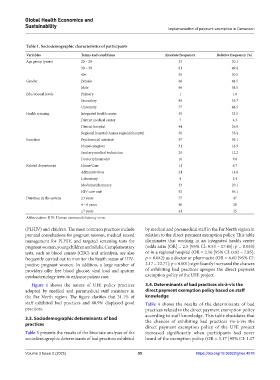
            Table 1. Sociodemographic characteristics of participants
            Variables              Terms and conditions                Absolute frequency    Relative frequency (%)
            Age group (years)      20 – 29                                   33                     20.1
                                   30 – 39                                   81                     49.4
                                   40+                                       50                     30.5
            Gender                 Female                                    68                     41.5
                                   Male                                      96                     58.5
            Educational levels     Primary                                   1                      1.8
                                   Secondary                                 88                     53.7
                                   University                                77                     44.5
            Health training        Integrated health center                  55                     33.5
                                   District medical center                   7                      4.3
                                   District hospital                         44                     26.8
                                   Regional hospital/Annex regional hospital  58                    35.4
            Function               Psychosocial assistant                    97                     59.1
                                   Nurse/caregiver                           31                     18.9
                                   Sanitary medical technician               20                     12.2
                                   Doctor/pharmacist                         16                     9.8
            Related department     Home/Care                                 11                     6.7
                                   Administration                            24                     14.6
                                   Laboratory                                4                      2.4
                                   Medicine/pharmacy                         33                     20.1
                                   HIV care unit                             92                     56.1
            Duration in the system  ≤3 years                                 77                     47
                                   4 – 6 years                               46                     28
                                   ≥7 years                                  41                     25
            Abbreviation: HIV: Human immunodeficiency virus.

            (PLHIV) and children. The most common practices include   by medical and paramedical staff in the Far North region in
            prenatal consultations for pregnant women, medical record   relation to the direct payment exemption policy. This table
            management for PLHIV, and targeted screening tests for   illuminates that working in an integrated health center
            pregnant women, young children and adults. Complementary   (odds ratio [OR] = 2.5 [95% CI: 0.53 – 17.45]; p = 0.033)
            tests, such as blood counts (CBC) and urinalysis, are also   or in a regional hospital (OR = 2.16 [95% CI: 0.02 – 7.85];
            frequently carried out to monitor the health status of HIV-  p = 0.042) as a doctor or pharmacist (OR = 6.60 [95% CI:
            positive pregnant women. In addition, a large number of   2.17 – 22.77]; p = 0.001) significantly increased the chances
            providers offer free blood glucose, viral load and sputum   of exhibiting bad practices apropos the direct payment
            cytobacteriology tests, to enhance patient care.   exemption policy of the UFE project.
              Figure  1  shows  the nature  of  UFE  policy  practices   3.4. Determinants of bad practices vis-à-vis the
            adopted by medical and paramedical staff members in   direct payment exemption policy based on staff
            the Far North region. The figure clarifies that 31.1% of   knowledge
            staff  exhibited  bad  practices  and  68.9%  displayed  good   Table  4 shows the results of the determinants of bad
            practices.                                         practices related to the direct payment exemption policy
                                                               according to staff knowledge. This table elucidates that
            3.3. Sociodemographic determinants of bad          the  chances  of  exhibiting  bad  practices  vis-à-vis  the
            practices
                                                               direct payment exemption policy of the UFE project
            Table 3 presents the results of the bivariate analyses of the   increased significantly when participants had never
            sociodemographic determinants of bad practices exhibited   heard of the exemption policy (OR = 3.17 [95% CI: 1.17


            Volume 3 Issue 2 (2025)                         55                       https://doi.org/10.36922/ghes.4078

