


Page 67 - GHES-3-2
P. 67
Global Health Economics and
            Sustainability
                                                                         Implementation of payment exemption in Cameroon


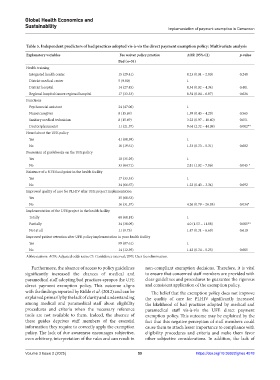
            Table 5. Independent predictors of bad practices adopted vis‑à‑vis the direct payment exemption policy: Multivariate analysis
            Explanatory variables                   Fee waiver policy practice   AOR (95% CI)          p‑value
                                                   Bad (n=51)
            Health training
             Integrated health center              15 (29.41)                    0.23 (0.01 – 2.80)    0.248
             District medical center               5 (9.80)                      1
             District hospital                     14 (27.45)                    0.34 (0.02 – 4.34)    0.401
             Regional hospital/annex regional hospital  17 (33.33)               0.54 (0.04 – 6.87)    0.626
            Functions
             Psychosocial assistant                24 (47.06)                    1
             Nurse/caregiver                       8 (15.69)                     1.39 (0.43 – 4.29)    0.565
             Sanitary medical technician           8 (15.69)                     3.22 (0.97 – 10.60)   0.051
             Doctor/pharmacist                     11 (21.57)                    9.64 (2.32 – 44.09)   0.002**
            Heard about the UFE policy
             Yes                                   41 (80.39)                    1
             No                                    10 (19.61)                    1.33 (0.33 – 5.31)    0.682
            Possession of guidebooks on the UFE policy
             Yes                                   18 (35.29)                    1
             No                                    33 (64.71)                    2.81 (1.02 – 7.86)    0.045 *
            Existence of a UFE focal point in the health facility
             Yes                                   17 (33.33)                    1
             No                                    34 (66.67)                    1.22 (0.43 – 3.34)    0.692
            Improved quality of care for PLHIV after UFE project implementation
             Yes                                   35 (68.63)
             No                                    16 (31.37)                    4.26 (0.79 – 26.95)   0.034*
            Implementation of the UFE project in the health facility
             Totally                               68 (60.18)                    1
             Partially                             34 (30.09)                    4.0 (1.53 – 11.08)    0.005**
             Not at all                            11 (9.73)                     1.47 (0.31 – 6.69)    0.610
            Improved patient retention after UFE policy implementation in your health facility
             Yes                                   99 (87.61)                    1
             No                                    14 (12.39)                    1.42 (0.34 – 5.25)    0.605
            Abbreviations: AOR: Adjusted odds ratio; CI: Confidence interval; UFE: User fees elimination.
              Furthermore, the absence of access to policy guidelines   non-compliant exemption decisions. Therefore, it is vital
            significantly increased the chances of medical and   to ensure that concerned staff members are provided with
            paramedical staff adopting bad practices apropos the UFE   clear guidelines and procedures to guarantee the rigorous
            direct payment exemption policy. This outcome aligns   and consistent application of the exemption policy.
            with the findings reported by Ridde et al. (2012) and can be   The belief that the exemption policy does not improve
            explained primarily by the lack of clarity and understanding   the quality of care for PLHIV significantly increased
            among medical and paramedical staff about eligibility   the likelihood of bad practices adopted by medical and
            procedures and criteria when the necessary reference   paramedical staff vis-à-vis the UFE direct payment
            tools are not available to them. Indeed, the absence of   exemption policy. This outcome may be explained by the
            these guides deprives staff members of the essential   fact that this negative perception of staff members could
            information they require to correctly apply the exemption   cause them to attach lesser importance to compliance with
            policy. The lack of due awareness encourages subjective,   eligibility procedures and criteria and make them favor
            even arbitrary, interpretation of the rules and can result in   other subjective considerations. In addition, the lack of


            Volume 3 Issue 2 (2025)                         59                       https://doi.org/10.36922/ghes.4078

