


Page 97 - GHES-3-2
P. 97
Global Health Economics and
            Sustainability
                                                                                     Student anxiety/stress/depression


              The results of the first Mann–Whitney U test (Table 1)   on DASS). The interquartile range (IQR) of the group of
            demonstrated a statistically significant difference between   students with children was 3.00 and this value was 4.75
            the two groups (students with and without children) only   for the group of students without children (Kent State
            in anxiety levels (U = 642, p = 0.005). The median of the   University, 2023). Furthermore, the mean value for the
            group of students with children was calculated at 1.00   group of students with children was reported at 1.69 and
            (normal anxiety levels based on DASS) and was 3.00 for   this statistic was 3.61 for the group of students without
            students without children (normal anxiety levels based   children. These values ranged within normal anxiety levels.
                                                                 The second Mann–Whitney U test found no statistically
                                                               significant differences in anxiety levels (p = 0.395), stress
                                                               (p = 0.721), and depression (p = 0.493) between women and
                                                               men (Table 2).The third Mann–Whitney U test evidenced
                                                               no statistically significant differences between employed
                                                               and unemployed participants in their levels of anxiety
                                                               (p = 0.073), stress (p = 0.053), and depression (p = 0.053).
                                                               Noteworthily, however, the employed participants
                                                               registered higher values in all three scores (Table 2). The
                                                               Kruskal–Wallis tests revealed no statistically significant
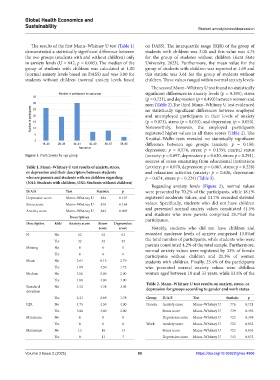
                                                               difference between age groups (anxiety:  p =  0.150,
                                                               depression:  p = 0.574, stress:  p = 0.159), marital status
            Figure 1. Participants by age group                (anxiety: p = 0.097, depression: p = 0.630, stress: p = 0.291),
                                                               sources of stress emanating from educational institutions
            Table 1. Mann–Whitney U test results of anxiety, stress,   (anxiety: p = 0.070, depression: p = 0.067, stress: p = 0.228)
            or depression and their descriptors between students   and relaxation activities (anxiety:  p =  0.626, depression:
            who are parents and students with no children regarding   p = 0.674, stress: p = 0.224) (Table 3).
            (NAI: Students with children, OXI: Students without children)
                                                                 Regarding anxiety levels (Figure  2), normal values
            D/A/S            Test         Statistic  p         were presented by 70.2% of the participants, while 18.1%
            Depression score  Mann–Whitney U  834   0.197      registered moderate values, and 11.7% recorded elevated
            Stress score     Mann–Whitney U  818    0.164      values. Specifically, students who did not have children
            Anxiety score    Mann–Whitney U  642    0.005      and presented normal anxiety values constituted 41.5%
                               Descriptives                    and students who were parents comprised 28.7%of the
                                                               participants.
            Descriptive   Kids  Anxiety score  Stress   Depression
                                           score    score        Notably, students who did not have children and
            N           No        62        62       62        recorded moderate levels of anxiety comprised 13.8%of
                        Yes       32        32       32        the total number of participants, while students who were
            Missing     No         0         0       0         parents constituted 4.2% of the total sample. Furthermore,
                                                               normal anxiety values were registered by 33% of female
                        Yes        0         0       0         participants without children and 21.3% of women
            Mean        No        3.61      6.15    2.79       students with children. Finally, 23.4% of the participants
                        Yes       1.69      4.50    1.72       who presented normal anxiety values were childless
            Median      No        3.00      5.00    2.00       women aged between 18 and 33 years, while 13.8% of the
                        Yes       1.00      4.00    1.00
                                                               Table 2. Mann–Whitney U test results on anxiety, stress, or
            Standard    No        3.52      4.38    3.03       depression for groups according to gender and work status
            deviation
                        Yes       2.21      2.69    1.78       Group   D/A/S       Test          Statistic  p
            IQR         No        4.75      4.50    4.00       Gender  Anxiety score  Mann–Whitney U  776  0.721
                        Yes       3.00      3.00    2.00              Stress score  Mann–Whitney U  739  0.493
            Minimum     No         0         0       0                Depression score  Mann–Whitney U  722  0.395
                        Yes        0         0       0         Work   Anxiety score  Mann–Whitney U  725  0.053
            Maximum     No        13        16       13               Stress score  Mann–Whitney U  723  0.053
                        Yes        8        11       7                Depression score  Mann–Whitney U  743  0.073


            Volume 3 Issue 2 (2025)                         89                       https://doi.org/10.36922/ghes.4906

