


Page 99 - GHES-3-2
P. 99
Global Health Economics and
            Sustainability
                                                                                     Student anxiety/stress/depression


                                                               al. (2017) reported that working students experience
                                                               increased levels of stress. The present study confirmed
                                                               that working students exhibited higher anxiety, stress, or
                                                               depression values than unemployed students, but not at
                                                               statistically significant levels. As previously mentioned,
                                                               Furr et al. (2001) evidenced with a sample of 1,455 students
                                                               (N = 1,455) that 50% of students were identified as depressed
            Figure  5.  Student perceptions of the sources of stress, anxiety, or   at some point in their studies. However, only 18.1% of the
            depression at their educational institutions and the relaxation techniques   participants in the present study displayed moderate and
            they employed.
                                                               elevated depression levels. The introduction section of this
                                                               paper referenced a study conducted by Dimitriou  et  al.
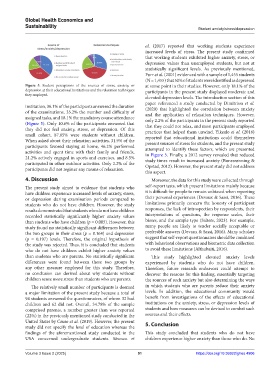
            institution, 36.1% of the participants answered the duration   (2020)  that highlighted  the correlation  between  anxiety
            of the examinations, 35.2% the number and difficulty of   and the application of relaxation techniques. However,
            assigned tasks, and 18.1% the mandatory course attendance   only 2.2% of the participants in the present study reported
            (Figure 5). Only 10.6% of the participants answered that   that they could not relax, and most participants employed
            they did not feel anxiety, stress, or depression. Of this   practices that helped them unwind. Yikealo et al. (2018)
            small cohort, 87.05% were students without children.   reported that educational institutions could themselves
            When asked about their relaxation activities, 31.9% of the   present sources of stress for students, and the present study
            participants favored staying at home, 46.2% performed   attempted to identify these factors, which are presented
            activities and spent time with their family and friends,   in Figure 5. Finally, a 2012 survey revealed that reduced
            21.2% actively engaged in sports and exercises, and 8.5%   study times result in increased anxiety (Bonesrønning &
            participated in other outdoor activities. Only 2.2% of the   Opstad, 2012). However, the present study did not address
            participants did not register any means of relaxation.
                                                               this aspect.
            4. Discussion                                        Moreover, the data for this study were collected through
            The present study aimed to evidence that students who   self-report tests, which present limitations mainly because
            have children experience increased levels of anxiety, stress,   it is difficult for people to remain unbiased when reporting
            or depression during examination periods compared to   their personal experiences (Devaux & Sassi, 2016). These
            students who do not have children. However, the study   limitations primarily concern the  honesty  of participant
            results demonstrated that students who do not have children   responses, the lack of introspection by respondents, their
            recorded statistically significantly higher anxiety values   interpretations of questions, the response scales, their
            than students who have children (p = 0.005). However, this   biases, and the sample type (Salters, 2023). For example,
            study found no statistically significant differences between   many people are likely to tender socially acceptable or
            the two groups in their stress (p = 0.164) and depression   preferable answers (Devaux & Sassi, 2016). Many scholars
            (p =  0.197) levels. Therefore, the original hypothesis of   suggest that self-report questionnaires should be combined
            the study was rejected. Thus, it is concluded that students   with behavioral observations and biometric data collection
            who do not have children exhibit higher anxiety values   to avoid these limitations (Althubaiti, 2016).
            than students who are parents. No statistically significant   This study highlighted elevated anxiety levels
            differences were found between these two groups by   experienced  by  students  who  do  not  have  children.
            any other measure employed for this study. Therefore,   Therefore, future research endeavors could attempt to
            no conclusion can derived about why students without   discover the reasons for this finding, essentially targeting
            children sense more stress than students who are parents.  the sources of such anxiety but also determining the ways

              The relatively small number of participants is deemed   in which students who are parents reduce their anxiety
            a major limitation of the present study because a total of   levels. In addition, the educational community would
            94 students answered the questionnaires, of whom 32 had   benefit from investigations of the effects of educational
            children and 62 did not. Overall, 34.78% of the sample   institutions on the anxiety, stress, or depression levels of
            comprised parents, a number greater than was reported   students and how measures can be devised to combat such
            (22%) in the previously mentioned study conducted in the   sources and their effects.
            United States by Cruse et al. (2019). However, the present
            study did not specify the level of education whereas the   5. Conclusion
            findings of the aforementioned study conducted in the   This study concluded that students who do not have
            USA  concerned  undergraduate  students.  Săvescu  et   children experience higher anxiety than those who do. No


            Volume 3 Issue 2 (2025)                         91                       https://doi.org/10.36922/ghes.4906

