


Page 10 - GHES-3-3
P. 10
Global Health Economics and
            Sustainability
                                                                                      Sustainable therapeutic Artemisia


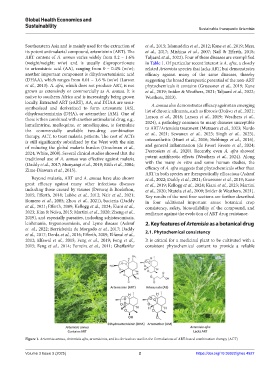
            Southeastern Asia and is mainly used for the extraction of   et al., 2015; Islamuddin et al., 2012; Kane et al., 2019; Mesa
            its potent antimalarial compound, artemisinin (ART). The   et  al., 2017; Mishina  et  al., 2007; Naß & Efferth, 2018;
            ART content of A. annua varies widely from 0.2 – 1.6%   Taljaard et al., 2022). Four of these diseases are exemplified
            (weight/weight; w/w) and is usually disproportionate   in Table 1. Of particular recent interest is A. afra, a closely
            to artemisinic acid (AA), ranging from 0 – 0.4% (w/w);   related Artemisia species that lacks ART, but demonstrates
            another important component is dihydroartemisinic acid   efficacy against many of the same diseases, thereby
            (DHAA), which ranges from 0.01 – 1.6 % (w/w) (Larson   suggesting the broad therapeutic potential of the non-ART
            et al., 2013). A. afra, which does not produce ART, is not   phytochemicals it contains (Gruessner et al., 2019; Kane
            grown as extensively or commercially as  A. annua. It is   et al., 2019; Snider & Weathers, 2021; Taljaard et al., 2022;
            native to southern Africa and is increasingly being grown   Weathers, 2023).
            locally. Extracted ART (eART), AA, and DHAA are semi-  A. annua also demonstrates efficacy against an emerging
            synthesized and derivatized to form artesunate (AS),   list of chronic ailments, such as fibrosis (Dolivo et al., 2021;
            dihydroartemisinin (DHA), or artemether (AM). One of   Larson  et al., 2018; Larson  et al., 2019; Weathers  et al.,
            these is then combined with another antimalarial drug, e.g.,   2024), a pathology common to many diseases susceptible
            lumefantrine, mefloquine, or amodiaquine, to formulate
            the commercially  available two-drug combination   to ART/Artemisia treatment (Mutsaers et al., 2023; Nardo
            therapy, ACT, to treat malaria patients. The cost of ACTs   et al., 2021; Sewanan  et al., 2023; Singh  et  al., 2023),
            is still significantly subsidized by the West with the aim   osteoarthritis (Hunt  et al., 2016; Stebbings  et  al., 2016),
            of reducing the global malaria burden (Goodman et al.,   and general inflammation (de Faveri Favero et al., 2024;
            2024; White, 2008). Several clinical studies showed that the   Desrosiers  et al., 2020). Recently, even  A. afra showed
            traditional use of A. annua was effective against malaria   potent antifibrotic effects (Weathers  et al., 2024). Along
            (Daddy et al., 2017; Munyangi et al., 2019; Räth et al., 2004;   with the many  in vitro and some human studies, the
            Zime-Diawara et al., 2015).                        efficacy of A. afra suggests that phytochemicals other than
                                                               ART in both species are therapeutically efficacious (Ashraf
              Beyond malaria, ART and A. annua have also shown   et al., 2022; Daddy et al., 2021; Gruessner et al., 2019; Kane
            great efficacy against many other infectious diseases   et al., 2019; Kellogg et al., 2024; Kiani et al., 2023; Martini
            including those caused by viruses (Devaraj & Roelofson,   et al., 2020; Ntutela et al., 2009; Snider & Weathers, 2021).
            2015; Efferth, 2018; Lubbe et al., 2012; Nair et al., 2021;   Key results of the next four sections are further described
            Romero et al., 2005; Zhou et al., 2021), bacteria (Daddy   in four additional important areas: botanical crop
            et al., 2021; Efferth, 2009; Kellogg et al., 2024; Kiani et al.,   consistency, safety, bioavailability of the compound, and
            2023; Kim & Neiva, 2015; Martini et al., 2020; Zheng et al.,   resilience against the evolution of ART drug resistance.
            2019), and especially parasites, including schistosomiasis,
            leishmania, trypanosomiasis, and Lyme disease (Ashraf   2. Key features of Artemisia as a botanical drug
            et  al., 2022; Berrizbeitia de Morgado et al., 2017; Daddy
            et al., 2017; Derda et al., 2016; Efferth, 2009; Elfawal et al.,   2.1. Phytochemical consistency
            2012; Elfawal  et al., 2015; Feng  et al., 2019; Feng  et al.,   It is critical for a medicinal plant to be cultivated with a
            2015; Feng  et  al., 2014; Ferreira  et  al., 2011; Ghaffarifar   consistent phytochemical  content to  provide a  reliable


            Figure 1. Artemisia annua, Artemisia afra, artemisinin, and its derivatives used in the formulations of ART-based combination therapy (ACT)


            Volume 3 Issue 3 (2025)                         2                        https://doi.org/10.36922/ghes.4927

