


Page 138 - GHES-3-3
P. 138
Global Health Economics and
            Sustainability
                                                                                 Polyvictimization and suicidal behaviors


                                                               from the people surrounding polyvictimized college
                                                               students, such as family members, peers, classmates, school
                                                               staff, and faculty, is a crucial factor in reducing students’
                                                               suicidal thoughts/behaviors. Perceiving others’ interest in
                                                               them may lead students to feel positive about themselves,
                                                               subsequently reducing their suicidal thoughts/behaviors.
                                                               To enhance the levels of perceived social support,
                                                               universities should consider  implementing campus-wide
                                                               actions. For instance, motivational interviewing (MI) is
                                                               an evidence-based approach that can be considered. This
                                                               approach is centered on “a respectful and curious way
                                                               of being with people that facilitate the natural process of
                                                               change and honors client autonomy” (Miller & Rollmeick,
                                                               2013). A systematic review reported that medical students
                                                               who received medical school–based MI could successfully
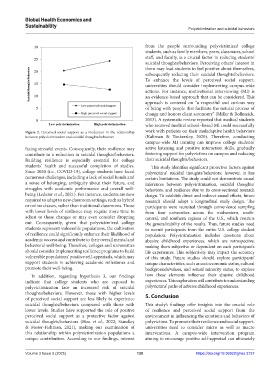
            Figure  2. Perceived social support as a moderator in the relationship   work with patients on their maladaptive health behaviors
            between polyvictimization and suicidal thoughts/behaviors  (Kaltman  &  Tankersley,  2020).  Therefore,  conducting
                                                               campus-wide MI training can improve college students’
            facing stressful events. Consequently, their resilience may   active listening and positive interaction skills, gradually
            contribute to a reduction in suicidal thoughts/behaviors.   fostering support for polyvictims on campus and reducing
            Building resilience is especially essential for college   their suicidal thoughts/behaviors.
            students’ health and successful completion of studies.   This study identifies significant protective factors against
            Since 2020 (i.e., COVID-19), college students have faced   polyvictims’ suicidal thoughts/behaviors; however, it has
            numerous challenges, including a lack of social bonds and   certain limitations. The study could not demonstrate causal
            a sense of belonging, ambiguity about their future, and   inferences between polyvictimization, suicidal thoughts/
            struggles with academic performance and overall well-  behaviors, and resilience due to its cross-sectional research
            being (Lederer et al., 2021). For instance, students are now   design. To establish direct and indirect causal effects, future
            required to adapt to new classroom settings, such as hybrid   research should adopt a longitudinal study design. The
            or online classes, rather than traditional classrooms. Those   participants  were  recruited  through  convenience  sampling
            with lower levels of resilience may require more time to   from four universities across the midwestern, south-
            adjust to these changes or may even consider dropping   central, and southern regions of the U.S., which restricts
            out. Consequently, given that polyvictimized college   the generalizability of the results. Thus, future studies need
            students represent vulnerable populations, the cultivation   to recruit participants from the entire U.S. college student
            of resilience could significantly enhance their likelihood of   population. Polyvictimization includes questions about
            academic success and contribute to their overall mental and   abusive  childhood  experiences,  which  are  retrospective,
            behavioral well-being. Therefore, colleges and universities   making them subjective or dependent on each participant’s
            should consider implementing resilience programs to build   life experiences. This subjectivity may impact the accuracy
            vulnerable populations’ positive self-appraisals, which may   of this study. Future studies should explore participants’
            support  students  in  achieving  academic  milestones  and   unique characteristics, such as socioeconomic status, cultural
            promote their well-being.                          backgrounds/values, and sexual minority status, to explore
              In addition, regarding hypothesis 3, our findings   how these elements influence their abusive childhood
            indicate that college students who are exposed to   experiences. This exploration will contribute to understanding
            polyvictimization face an increased risk of suicidal   polyvictims’ paths of adverse childhood experiences.
            thoughts/behaviors. However, those with higher levels
            of  perceived  social  support are less likely  to experience   5. Conclusion
            suicidal  thoughts/behaviors  compared  with  those  with   This study’s findings offer insights into the crucial role
            lower  levels.  Studies  have  supported  the  role  of  positive   of resilience and perceived social support from the
            perceived social support as a protective factor against   environment in influencing the emotions and behaviors of
            suicidal  thoughts/behaviors  (Hou  et al.,  2022;  Standley   polyvictims. To promote their resilience and social support,
            & Foster‐Fishman, 2021), making our examination of   universities need to consider micro as well as macro
            this relationship within polyvictimization populations a   interventions. A  campus-wide intervention program
            unique contribution. According to our findings, interest   aiming to encourage positive self-appraisal can ultimately


            Volume 3 Issue 3 (2025)                        130                       https://doi.org/10.36922/ghes.3737

