


Page 174 - GHES-3-3
P. 174
Global Health Economics and
            Sustainability
                                                                                   Path model of child marriage in Africa


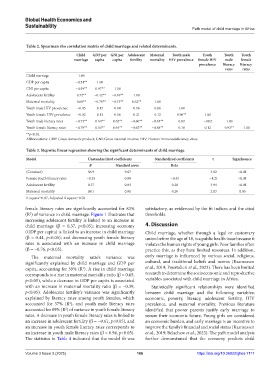
            Table 2. Spearman rho correlation matrix of child marriage and related determinants.
                                  Child   GDP per  GNI per  Adolescent   Maternal   Youth male   Youth   Youth   Youth
                                marriage  capita  capita  fertility  mortality  HIV prevalence  female HIV   male   female
                                                                                      prevalence  literacy   literacy
                                                                                                 rates  rates
            Child marriage        1.00
            GDP per capita       −0.54**  1.00
            GNI per capita       −0.59**  0.97**  1.00
            Adolescent fertility  0.72**  −0.42**  −0.46**  1.00
            Maternal mortality    0.68**  −0.70**  −0.74**  0.62**  1.00
            Youth male HIV prevalence  −0.05  0.15  0.08  0.16     0.06      1.00
            Youth female HIV prevalence  −0.02  0.13  0.06  0.21   0.12     0.96**      1.00
            Youth male literacy rates  −0.73**  0.60**  0.62**  −0.60**  −0.65**  0.02  −0.02    1.00
            Youth female literacy rates  −0.79**  0.60**  0.64**  −0.63**  −0.68**  0.18  0.12   0.93**  1.00
            **p<0.01.
            Abbreviations: GDP: Gross domestic product; GNI: Gross national income; HIV: Human immunodeficiency virus.

            Table 3. Stepwise linear regression showing the significant determinants of child marriage

            Model                     Unstandardized coefficients  Standardized coefficients  t     Significance
                                       B          Standard error          Beta
            (Constant)                36.9            9.67                                 3.82       <0.01
            Female youth literacy rates  −0.35        0.08                −0.45           −4.21       <0.01
            Adolescent fertility      0.17            0.04                0.38             3.94       <0.01
            Maternal mortality        0.01            0.01                0.20             2.03        0.05
            R square=0.87, Adjusted R square=0.76.

            female literacy rates are significantly accounted for 83%   satisfactory, as evidenced by the fit indices and the cited
            (R ) of variance in child marriage. Figure 1 illustrates that   thresholds.
              2
            increasing adolescent fertility is linked to an increase in
            child marriage (β = 0.37,  p<0.05); increasing economy   4. Discussion
            (GDP per capita) is linked to an increase in child marriage   Child  marriage,  whether  through  a  legal  or  customary
            (β = 0.44, p<0.05); and decreasing youth female literacy   union before the age of 18, is a public health issue because it
            rates is associated with an increase in child marriage   violates the human rights of young girls. Poor families often
            (β = −0.76, p<0.05).                               practice this, as they have limited resources. In addition,

              The maternal mortality ratio’s variance was      early  marriage  is  influenced  by  various  social,  religious,
            significantly explained by child marriage and GDP per   cultural, and traditional beliefs and norms (Rasmussen
            capita, accounting for 59% (R ). A rise in child marriage   et al., 2019; Pourtaheri et al., 2023). There has been limited
                                    2
            corresponds to a rise in maternal mortality ratio (β = 0.65,   research to determine the socioeconomic and reproductive
            p<0.05), while a decrease in GDP per capita is associated   variables associated with child marriage in Africa.
            with an increase in maternal mortality ratio (β = −0.39,   Statistically significant relationships were identified
            p<0.05). Adolescent fertility’s variance was significantly   between child marriage and the following variables:
            explained by literacy rates among youth females, which   economic, poverty, literacy, adolescent fertility, HIV
            accounted for 37% (R ), and youth male literacy rates   prevalence, and maternal mortality. Previous literature
                               2
            accounted for 89% (R ) of variance in youth female literacy   identified that poorer parents justify early marriage to
                             2
            rates. A decrease in youth female literacy rates is linked to   secure their economic future. Young girls are considered
            an increase in adolescent fertility (β = −0.61, p<0.05), and   an economic burden, and early marriage is an incentive to
            an increase in youth female literacy rates corresponds to   improve the family’s financial and social status (Rasmussen
            an increase in youth male literacy rates (β = 0.94, p<0.05).   et al., 2019; Belachew et al., 2023). The path model analysis
            The statistics in Table 4 indicated that the model fit was   further demonstrated that the economy predicts child


            Volume 3 Issue 3 (2025)                        166                       https://doi.org/10.36922/ghes.7117

