


Page 175 - GHES-3-3
P. 175
Global Health Economics and
            Sustainability
                                                                                   Path model of child marriage in Africa


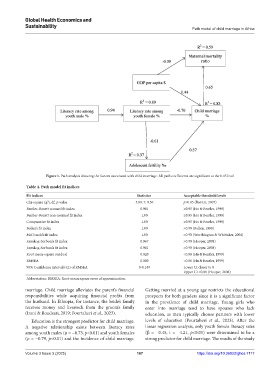
                     Figure 1. Path analysis showing the factors associated with child marriage. All path coefficients are significant at the 0.05 level

            Table 4. Path model fit indices
            Fit indices                                    Statistics          Acceptable threshold levels
            Chi-square (χ ), df, p-value                   5.80, 7, 0.56       p>0.05 (Barrett, 2007)
                     2
            Bentler-Bonett normed fit index                  0.981             ≥0.95 (Hu & Bentler, 1999)
            Bentler-Bonett non-normed fit index              1.00              ≥0.95 (Hu & Bentler, 1999)
            Comparative fit index                            1.00              ≥0.95 (Hu & Bentler, 1999)
            Bollen’s fit index                               1.00              >0.90 (Bollen, 1990)
            McDonald’s fit index                             1.00              >0.90 (Worthington & Whittaker, 2006)
            Joreskog-Sorbom’s fit index                      0.967             >0.90 (Hooper, 2008)
            Joreskog-Sorbom’s fit index                      0.901             >0.90 (Hooper, 2008)
            Root mean-square residual                        0.020             <0.08 (Hu & Bentler, 1999)
            RMSEA                                            0.000             <0.06 (Hu & Bentler, 1999)
            90% Confidence interval (CI) of RMSEA           0-0.149            Lower CI closer to 0
                                                                               Upper CI <0.08 (Hooper, 2008)
            Abbreviation: RMSEA: Root-mean square error of approximation.

            marriage. Child marriage alleviates the parent’s financial   Getting married at a young age restricts the educational
            responsibilities while acquiring financial profits from   prospects for both genders since it is a significant factor
            the husband. In Ethiopia, for instance, the bride’s family   in the prevalence of child marriage. Young girls who
            receives money and livestock from the  groom’s family   enter into marriage tend to have spouses who lack
            (Irani & Roudsari, 2019; Pourtaheri et al., 2023).  education, as men typically choose partners with lower
              Education is the strongest predictor for child marriage.   levels of education (Pourtaheri  et al., 2023). After the
            A  negative relationship exists between literacy rates   linear regression analysis, only youth female literacy rates
            among youth males (ρ = −0.73, p<0.01) and youth females   (β = −0.45, t = −4.21, p<0.05) were determined to be a
            (ρ = −0.79, p<0.01) and the incidence of child marriage.   strong predictor for child marriage. The results of the study


            Volume 3 Issue 3 (2025)                        167                       https://doi.org/10.36922/ghes.7117

