


Page 209 - GHES-3-3
P. 209
Global Health Economics and
            Sustainability
                                                                                        Neonatal mortality in Pakistan


            status (employed vs. unemployed), and newborn death
            (survived vs. not survived).
              One of the main advantages of the binary logistic
            regression model  is that it does not assume  a linear
            relationship between dependent and independent
            variables. Unlike standard regression models, which
            require normally distributed variables and the assumption
            of constant variance, logistic regression is more flexible. It
            performs well with skewed or unbalanced datasets because
            its  error  term  follows  a  binomial  distribution instead of
            a normal distribution. In addition, logistic regression
            allows for the inclusion of both categorical and continuous   Figure  1.  Neonatal mortality by place of delivery in urban regions of
            independent variables, making it a powerful tool for   Pakistan Note: 0: If delivery takes place outside facility; 1: If delivery takes
            analyzing  diverse  datasets.  For  instance,  in  the  context   place within facility.
            of NM, independent variables such as place of delivery,   Abbreviations: KP: Khyber Pakhtunkhwa; ICT/AJK/GB: Islamabad
            maternal education level, and household wealth status   Capital Territory/Azad Jammu Kashmir/Gilgit Baltistan.
            (categorical variables), as well as maternal age and birth
            weight (continuous variables), can be included in a single
            model without requiring complex transformations.

            3. Results
            Graphical representations of the relationship between the
            place of delivery and NM at the provincial and residential
            levels are shown in Figure 1  and 2. In these figures, the
            place of delivery (within facilities labeled as “1” while
            outside healthcare facilities labeled as “0”) is measured
            on the x-axis, whereas NM is measured on the y-axis.
            Figure 1 presents data for urban regions, including Punjab,
            Sindh, Khyber Pakhtunkhwa (KP), Balochistan, and the   Figure 2. Neonatal mortality by place of delivery in rural areas of Pakistan
            combined impact of Islamabad Capital Territory/Azad   Note: 0: If delivery takes place outside facility; 1: If delivery takes place
            Jammu Kashmir/Gilgit Baltistan (ICT/AJK/GB), whereas   within facility.
            Figure 2 represents the rural regions of Pakistan.  Abbreviations: KP: Khyber Pakhtunkhwa; ICT/AJK/GB: Islamabad
                                                               Capital Territory/Azad Jammu Kashmir/Gilgit Baltistan.
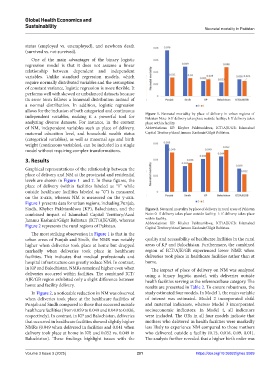
              The most striking observation in Figure 1 is that in the
            urban areas of Punjab and Sindh, the NMR was notably   quality and accessibility of healthcare facilities in the rural
            higher when deliveries took place at home but dropped   areas of KP and Balochistan. Furthermore, the combined
            markedly when deliveries took place in healthcare   region of ICT/AJK/GB experienced lower NMR when
            facilities. This indicates that medical professionals and   deliveries took place in healthcare facilities rather than at
            hospital infrastructure can greatly reduce NM. In contrast,   home.
            in KP and Balochistan, NMRs remained higher even when   The impact of place of delivery on NM was analyzed
            deliveries occurred within facilities. The combined ICT/  using a binary logistic model, with deliveries outside
            AJK/GB region exhibited only a slight difference between   health facilities serving as the reference/base category. The
            home and facility delivery.                        results are presented in Table 2. To ensure robustness, the
              In Figure 2, a noticeable reduction in NM was observed   study estimated four models. In Model 1, the main variable
            when  deliveries  took  place  at  the  healthcare  facilities of   of interest was estimated. Model 2 incorporated child
            Punjab and Sindh compared to those that occurred outside   and maternal indicators, whereas Model 3 incorporated
            healthcare facilities (from 0.059 to 0.049 and 0.049 to 0.036,   socioeconomic indicators. In Model 4, all indicators
            respectively). In contrast, in KP and Balochistan, deliveries   were included. The ORs in all four models indicate that
            that occurred in healthcare facilities showed slightly higher   mothers who delivered in health facilities were markedly
            NMRs (0.049 when delivered in facilities and 0.041 when   less likely to experience NM compared to those mothers
            delivery took place at home in KP, and 0.052 vs. 0.049 in   who delivered outside a facility (0.15, 0.016, 0.09, 0.01).
            Balochistan). These findings highlight issues with the   The analysis further revealed that a higher birth order was


            Volume 3 Issue 3 (2025)                        201                       https://doi.org/10.36922/ghes.5089

