


Page 210 - GHES-3-3
P. 210
Global Health Economics and
            Sustainability
                                                                                        Neonatal mortality in Pakistan


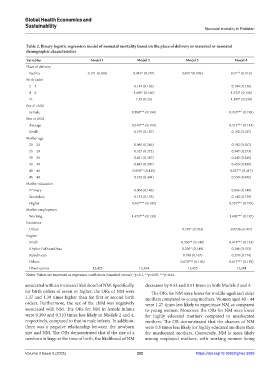
            Table 2. Binary logistic regression model of neonatal mortality based on the place of delivery or maternal or neonatal
            demographic characteristics
            Variables                   Model 1            Model 2              Model 3              Model 4
            Place of delivery
             Facility                 0.151 (0.100)       0.016* (0.107)       0.091*(0.106)       0.01** (0.110)
            Birth order
             2 – 3                        -               0.114 (0.136)            -                0.104 (0.136)
             4 – 6                        -               1.494* (0.166)           -               1.532* (0.166)
             7+                           -                1.37 (0.23)             -               1.391* (0.230)
            Sex of child
             Female                       -              0.309*** (0.194)          -               0.310*** (0.195)
            Size of child
             Average                      -              0.534*** (0.114)          -               0.512*** (0.114)
             Small                        -               0.197 (0.187)            -                0.160 (0.187)
            Mother age
             20 – 24                      -               0.085 (0.266)            -                0.102 (0.267)
             25 – 29                      -               0.327 (0.272)            -                0.347 (0.273)
             30 – 34                      -               0.421 (0.287)            -                0.443 (0.288)
             34 – 39                      -               0.447 (0.307)            -                0.453 (0.308)
             40 – 44                      -              0.016** (0.415)           -               0.027** (0.417)
             45 – 49                      -               0.552 (0.494)            -                0.550 (0.495)
            Mother education
             Primary                      -               0.004 (0.146)            -                0.066 (0.149)
             Secondary                    -               0.132 (0.135)            -                0.140 (0.139)
             Higher                       -              0.567*** (0.192)          -               0.527*** (0.197)
            Mother employment
             Working                      -              1.473*** (0.133)          -               1.402*** (0.137)
            Residence
             Urban                        -                   -               0.195* (0.103)       0.0726 (0.107)
            Region
             Sindh                        -                   -               0.356** (0.149)      0.418*** (0.153)
             Khyber Pakhtunkhwa           -                   -               0.256* (0.148)        0.246 (0.153)
             Balochistan                  -                   -                0.188 (0.167)        0.270 (0.174)
             Others                       -                   -               0.670*** (0.136)     0.617*** (0.139)
             Observations               12,425              12,384               12,425               12,384
            Notes: Values are expressed as regression coefficients (standard errors); *p<0.1, **p<0.05, ***p<0.01.

            associated with an increased likelihood of NM. Specifically,   decreases by 0.53 and 0.51 times in both Models 2 and 4.
            for birth orders of seven or higher, the ORs of NM were   The ORs for NM were lower for middle-aged and older
            1.37 and 1.39 times higher than for first or second birth   mothers compared to young mothers. Women aged 40 – 44
            orders. Furthermore, the sex of the child was negatively   were 1.27 times less likely to experience NM as compared
            associated with NM. The ORs for NM in female infants   to young women. Moreover, the ORs for NM were lower
            were 0.309 and 0.310 times less likely in Models 2 and 4,   for highly educated mothers compared to uneducated
            respectively, compared to that in male infants. In addition,   mothers. The OR demonstrated that the chances of NM
            there was a negative relationship between the newborn   were 0.5 times less likely for highly educated mothers than
            size and NM. The ORs demonstrated that if the size of a   for uneducated mothers. Conversely, NM is more likely
            newborn is large at the time of birth, the likelihood of NM   among employed mothers, with working women being


            Volume 3 Issue 3 (2025)                        202                       https://doi.org/10.36922/ghes.5089

