


Page 54 - GPD-1-1
P. 54
Gene & Protein in Disease                                             Bangladesh genetic disease database


            Table 1. (Continued).

             Genetic diseases     Inheritance mode      Diagnosis procedure          Publishing year of   Reference
                                                                                     the first case report
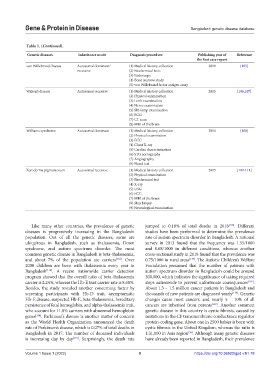
            von Willebrand disease   Autosomal dominant/  (1) Medical history collection  2019         [105]
                                  recessive             (2) Biochemical tests
                                                        (3) Endoscopy
                                                        (4) Bone marrow study
                                                        (5) von Willebrand factor antigen assay
            Wilson’s disease      Autosomal recessive   (1) Medical history collection    2015        [106,107]
                                                        (2) Physical examination
                                                        (3) Limb examination
                                                        (4) Nerve examination
                                                        (5) Slit-lamp examination
                                                        (6) ECG
                                                        (7) CT scan
                                                        (8) MRI of the brain
            Williams syndrome     Autosomal dominant    (1) Medical history collection    2014         [108]
                                                        (2) Physical examination
                                                        (3) ECG
                                                        (4) Chest X-ray
                                                        (5) Cardiac characterization
                                                        (6) STG aortography
                                                        (7) Angiography
                                                        (8) Blood test
            Xeroderma pigmentosum  Autosomal recessive  (1) Medical history collection    2005        [109-111]
                                                        (2) Physical examination
                                                        (3) Biochemical test
                                                        (4) X-ray
                                                        (5) USG
                                                        (6) ECG
                                                        (7) MRI of the brain
                                                        (8) Skin biopsy
                                                        (9) Neurological examination


              Like many other countries, the prevalence of genetic   jumped to 0.18% of  total deaths in 2018 [116] . Different
            diseases is progressively increasing in the Bangladeshi   studies have been performed to determine the prevalence
            population. Out of all the genetic diseases, some are   rate of autism spectrum disorder in Bangladesh. A national
            ubiquitous in Bangladesh, such as thalassemia, Down   survey in 2013 found that the frequency was 1.55/1000
            syndrome, and autism spectrum disorder. The most   and 0.68/1000 in different conditions, whereas another
            common genetic disease in Bangladesh is beta-thalassemia,   cross-sectional study in 2018 found that the prevalence was
            and about 7% of the population are carriers [112] . Over   0.75/1000 in rural areas [117] . The Autistic Children’s Welfare
            2000 children are born with thalassemia every year in   Foundation  presumed  that  the  number  of  patients  with
            Bangladesh [113] . A  recent nationwide carrier detection   autism spectrum disorder in Bangladesh could be around
            program showed that the overall ratio of beta-thalassemia   300,000, which indicates the significance of taking required
            carrier is 2.24%, whereas the Hb-E trait carrier rate is 8.68%.   steps nationwide to prevent unfortunate consequences [118] .
            Besides, the study revealed another concerning factor by   About 1.3 – 1.5 million cancer patients in Bangladesh and
            screening participants with Hb-D trait, asymptomatic   thousands of new patients are diagnosed yearly [119] . Genetic
            Hb-E disease, suspected Hb-E, beta-thalassemia, hereditary   changes cause most cancers, and nearly 5 – 10% of all
            persistence of fetal hemoglobin, and alpha-thalassemia trait,   cancers are inherited from parents [119] .  Another  common
            who account for 11.8% carriers with abnormal hemoglobin   genetic disease in this country is cystic fibrosis, caused by
            genes [114] . Parkinson’s disease is another matter of concern   mutations in the CF transmembrane conductance regulator
            as the World Health Organization announced the death   protein-coding gene. About one in 2500 babies is born with
            rate of Parkinson’s disease, which is 0.07% of total deaths in   cystic fibrosis in the United Kingdom, whereas the ratio is
                                                                                 [38]
            Bangladesh in 2017. The number of deceased individuals   1:31,000 in Asia region . Although many genetic diseases
            is  increasing  day  by  day [115] .  Surprisingly,  the  death  rate   have already been reported in Bangladesh, their prevalence

            Volume 1 Issue 1 (2022)                         9                       https://doi.org/10.36922/gpd.v1i1.78

