


Page 56 - GPD-1-1
P. 56
Gene & Protein in Disease                                             Bangladesh genetic disease database


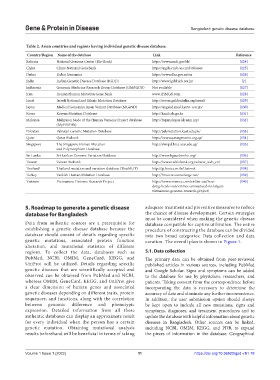
            Table 2. Asian countries and regions having individual genetic disease database.
             Country/Region  Name of the database                 Link                               Reference
            Bahrain      National Genome Center (Bio-Bank)        https://www.moh.gov.bh/              [124]
            China        China National GeneBank                  https://ngdc.cncb.ac.cn/databases    [125]
            Dubai        Dubai Genomics                           https://www.dha.gov.ae/en            [126]
            India        Indian Genetic Disease Database (IGDD)   http://www.igdd.iicb.res.in/          [2]
            Indonesia    Genomic Medicine Research Group Database (GMRGDB)  Not available              [127]
            Iran         Iranian Human Mutation Gene Bank         www.IHMGB.com                        [128]
            Israel       Israeli National and Ethnic Mutation Database  http://server.goldenhelix.org/israeli  [129]
            Japan        Medical Genomics Japan Variant Database (MGeND)  https://mgend.med.kyoto-u.ac.jp/  [130]
            Korea        Korean Mutation Database                 http://kmd.cdc.go.kr                 [131]
            Malaysia     Malaysian Node of the Human Variome Project database   http://hvpmalaysia.kk.usm.my/  [132]
                         (MyHVPDb)
            Pakistan     Pakistan Genetic Mutation Database       http://pakmutation.kust.edu.pk/      [133]
            Qatar        Qatar Biobank                            https://www.qatargenome.org.qa/      [134]
            Singapore    The Singapore Human Mutation             http://shmpd.bii.a-star.edu.sg/      [135]
                         and Polymorphism Database
            Sri Lanka    Sri Lankan Genome Variation Database     http://www.hgucolombo.org/           [136]
            Taiwan       Taiwan Biobank                           https://www.twbiobank.org.tw/new_web_en/  [137]
            Thailand     Thailand mutation and variation database (ThaiMUT)  http://gi.biotec.or.th/thaimut  [138]
            Turkey       Turkish Human Mutation Database          http://hmut-tr.sourceforge.net/      [139]
            Vietnam      Vietnamese Genome Research Project       https://www.vinmec.com/en/tin-tuc/hoat-  [140]
                                                                  dong-benh-vien/vinmec-announced-its-largest-
                                                                  vietnamese-genome-research-project/


            5. Roadmap to generate a genetic disease           adequate treatment and preventive measures to reduce
            database for Bangladesh                            the chance of disease development. Certain strategies
                                                               must be considered when making the genetic disease
            Data from authentic sources are a prerequisite for   database compatible for captive utilization. The entire
            establishing a genetic disease  database because  the   procedure of constructing the database can be divided
            database should consist of details regarding specific   into two broad categories: Data collection and data
            genetic mutations, associated protein function     curation. The overall plan is shown in Figure 1.
            alteration, and mutational statistics of different
            regions. To collect the data, databases such as    5.1. Data collection
            PubMed, NCBI, OMIM, GeneCard, KEGG, and            The primary data can be obtained from peer-reviewed
            UniProt will be utilized. Details regarding specific   published articles in various sources, including PubMed
            genetic diseases that are scientifically accepted and   and Google Scholar. Signs and symptoms can be added
            observed  can  be  obtained  from  PubMed  and  NCBI,   to the database for use by physicians, researchers, and
            whereas OMIM, GeneCard, KEGG, and UniProt give     patients. Taking consent from the correspondence before
            a clear dimension of human genes and associated    incorporating the data is necessary to determine the
            genetic diseases depending on different traits, protein   accuracy of data and eliminate any further inconvenience.
            sequences, and functions, along with the correlation   In addition, the user submission option should always
            between   genomic   difference  and  phenotypic    be kept open to include all new mutations, signs and
            expression. Detailed information from all these    symptoms, diagnoses, and treatment procedures and to
            authentic databases can display an approximate result   update the database with helpful information about genetic
            for every individual when the person has a certain   diseases  in  Bangladesh.  Other  sources  can  be  linked,
            genetic mutation. Obtaining mutational analysis    including NCBI, OMIM, KEGG, and PDB, to expand
            results beforehand will be beneficial in terms of taking   the pieces of information in the database. Geographical


            Volume 1 Issue 1 (2022)                         11                      https://doi.org/10.36922/gpd.v1i1.78

