


Page 66 - GPD-1-1
P. 66
Gene & Protein in Disease                                   A novel USH2A gene mutation in retinitis pigmentosa


            (USH2A) gene . Therefore, this study was conducted   abnormalities noted in the vestibular function examination.
                        [4]
            to screen and analyze  the  USH2A gene mutations  in a   Therefore, the proband was clinically diagnosed as non-
            Chinese family with RP.                            syndromic RP.

            2. Case presentation                                 Next, the proband’s mother had light perception in
                                                               both her right and left eyes, with yellowish-white opacity
            2.1. Clinical findings                             of the lens. Furthermore, fundus photography revealed

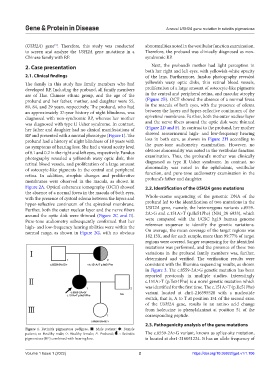
            The family in this study has family members who had   yellowish  waxy  optic  disks,  thin  retinal  blood  vessels,
            developed RP. Including the proband, all family members   proliferation of a large amount of osteocyte-like pigments
            are of Han Chinese ethnic group, and the age of the   in the central and peripheral retina, and macular atrophy
            proband and her father, mother, and daughter were 55,   (Figure 2B). OCT showed the absence of a normal fovea
            89, 84, and 29 years, respectively. The proband, who had   in the macula of both eyes, with the presence of edema
            an approximately 37-year history of night blindness, was   between the layers and hyper-reflective continuum of the
            diagnosed with non-syndromic RP, whereas her mother   epiretinal membrane. Further, both the outer nuclear layer
            was diagnosed with type II Usher syndrome. In contrast,   and the nerve fibers around the optic disk were thinned
            her father and daughter had no clinical manifestations of   (Figure 2D and F). In contrast to the proband, her mother
            RP and presented with a normal phenotype (Figure 1). The   showed sensorineural high-  and low-frequency hearing
            proband had a history of night blindness of 18 years with   loss in both ears, as shown in  Figure  2H according to
            no symptoms of hearing loss. She had a visual acuity level   the pure-tone audiometry examination. However, no
            of 0.1 and 0.2 in the right and left eyes, respectively. Fundus   obvious abnormality was noted in the vestibular function
            photography revealed a yellowish waxy optic disk, thin   examination. Thus,  the  proband’s mother  was clinically
            retinal blood vessels, and proliferation of a large amount   diagnosed as type  II Usher syndrome. In contrast, no
            of osteocyte-like pigments in the central and peripheral   abnormality was noted in the ophthalmic, vestibular
            retina.  In  addition,  atrophic  changes  and  proliferative   function, and pure-tone audiometry examination in the
            membranes were observed in the macula, as shown in   proband’s father and daughter.
            Figure 2A. Optical coherence tomography (OCT) showed   2.2. Identification of the USH2A gene mutations
            the absence of a normal fovea in the macula of both eyes,
            with the presence of cystoid edema between the layers and   Whole-exome sequencing of the genomic DNA of the
            hyper-reflective continuum of the epiretinal membrane.   proband led to the identification of two mutations in the
            Further, both the outer nuclear layer and the nerve fibers   USH2A gene, namely, the heterozygous variants c.8559-
            around the optic disk were  thinned (Figure  2C  and  E).   2A>G and c.151A>T (p.Ile51Phe) (NM_20 6933), which
            Pure-tone audiometry subsequently confirmed that her   were compared with the UCSC hg19 human genome
            high- and low-frequency hearing abilities were within the   reference  sequence to  identify  the genetic variations.
            normal range, as shown in  Figure  2G, with no obvious   On average, the mean coverage of the target regions was
                                                               182.13X, and for each sample, more than 99.77% of target
                                                               regions were covered. Sanger sequencing for the identified
                                                               mutations was performed, and the presence of these two
                                                               variations in the proband family members was, further,
                                                               determined and verified. The verification results were
                                                               consistent with the Illumina sequencing results, as shown
                                                               in Figure 3. The c.8559-2A>G genetic mutation has been
                                                               reported previously in multiple studies. Interestingly
                                                               c.151A>T (p.Ile51Phe) is a novel genetic mutation which
                                                               was identified for the first time. The c.151A>T (p.Ile51Phe)
                                                               variant  located  at  chr1-216595528  with  a nucleotide
                                                               switch, that is, A to T at position 151 of the second exon
                                                               of the  USH2A gene, results in an amino acid change
                                                               from isoleucine to phenylalaninat at position 51 of the
                                                               corresponding peptide.

                                                               2.3. Pathogenicity analysis of the gene mutations
            Figure  1.  Retinitis pigmentosa pedigree.  ■: Male patient;  ●: Female
            patient; □: Healthy male; ○: Healthy female; ↗: Proband;    : Retinitis   The c.8559-2A>G variant, known as splice-site mutation,
            pigmentosa (RP) combined with hearing loss.        is located at chr1-216051224. It has an allele frequency of


            Volume 1 Issue 1 (2022)                         2                      https://doi.org/10.36922/gpd.v1i1.106

