


Page 8 - GPD-2-1
P. 8
Gene & Protein in Disease                                                     AI-based drug repositioning


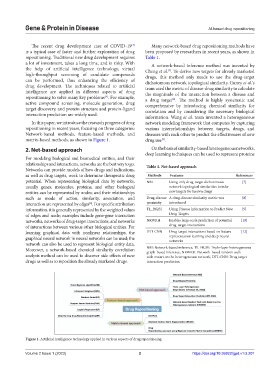
              The recent drug development case of COVID-19       Many network-based drug repositioning methods have
                                                         [4]
            is a typical case of faster and further exploration of drug   been proposed by researchers in recent years, as shown in
            repositioning. Traditional new drug development requires   Table 1.
            a lot of investment, takes a long time, and is risky. With   A network-based inference method was invented by
            the help of artificial intelligence technology, virtual   Cheng et al. . To derive new targets for already marketed
                                                                        [7]
            high-throughput screening of candidate compounds   drugs, this method only needs to use the drug-target
            can be performed, thus enhancing the efficiency of   dichotomous network topological similarity. Guney et al.’s
            drug development. The techniques related to artificial   team used the metric of disease-drug similarity to calculate
            intelligence are applied in different aspects of drug   the magnitude of the interaction between a disease and
            repositioning to solve many key problems . For example,   a drug target . The method is highly systematic and
                                              [5]
                                                                          [8]
            active compound screening, molecule generation, drug   comprehensive by introducing chemical similarity for
            target discovery, and protein structure and protein-ligand   correlation and by considering the necessary biological
            interaction prediction are widely used.            information. Wang et al. team invented a heterogeneous
              In this paper, we introduce the research progress of drug   network modeling framework that computes by capturing
            repositioning in recent years, focusing on three categories:   various interrelationships between targets, drugs, and
            Network-based methods, feature-based methods, and   diseases with each other to predict the effectiveness of new
            matrix-based methods, as shown in Figure 1.        drug use .
                                                                      [9]
            2. Net-based approach                                On the basis of similarity-based heterogeneous networks,
                                                               deep learning techniques can be used to represent proteins
            For modeling biological and biomedical entities, and their
            relationships and interactions, networks are the best way to go.   Table 1. Net‑based approach
            Networks can provide models of how drugs and indications,
            as well as drug targets, work to determine therapeutic drug   Methods  Features          References
            potential.  When representing  biological data by networks,   NBI  Using only drug-target dichotomous   [7]
            usually genes, molecules, proteins, and other biological     network topological similarities to infer
            entities can be represented by nodes; and their relationships   new targets for known drugs
            such  as  mode  of  action,  similarity,  association,  and   Drug-disease  A drug-disease similarity metric was   [8]
            interaction are represented by edges . For specific attribution   proximity  introduced
                                       [6]
            information, it is generally represented by the weighted values   TL_HGBI  Using Disease Information to Predict New   [9]
            of edges and node; examples include gene-gene interaction    Drug Targets
            networks, networks of drug-target interactions, and networks   NRWRH  Enables large-scale prediction of potential   [10]
            of interactions between various other biological entities. For   drug-target interactions
            learning graphical data with nonlinear relationships, the   DTI-CNN  Drug-target interactions based on feature   [12]
            graphical neural network in neural networks can be used; the   representation learning and deep neural
                                                                         networks
            network can also be used to represent biological entity data.
            Moreover,  a  network-based  chemical  similarity  correlation   NBI: Network-based inference, TL_HGBI: Triple-layer heterogeneous
                                                               graph-based inference, NRWRH: Network-based random walk
            analysis method can be used to discover side effects of new   with restart on the heterogeneous network, DTI-CNN: Drug target
            drugs as well as to reposition the already marketed drugs.  interaction prediction.


            Figure 1. Artificial intelligence technology applied in various aspects of drug repositioning.


            Volume 2 Issue 1 (2023)                         2                      https://doi.org/10.36922/gpd.v1i3.201

