


Page 68 - GPD-2-2
P. 68
Gene & Protein in Disease                                            Genetics of arteriovenous malformations


                                                               with a thorough analysis of emerging treatment options for
                                                               bAVM, based on its genetic profile.
                                                               2. Etiology and pathogenesis of AVM

                                                               2.1. Etiology and epidemiology
                                                               bAVM is twisted networks of blood vessels derived from
                                                               abnormal capillary network development which leads to
                                                               direct connections between cerebral arteries and veins .
                                                                                                           [11]
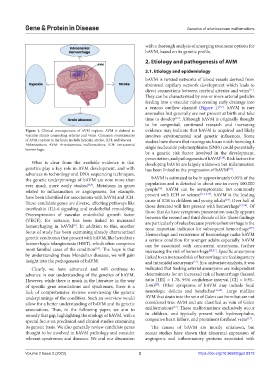
                                                               They can be characterized by one or more arterial pedicles
                                                               feeding into a vascular nidus creating early drainage into
                                                               a venous outflow channel (Figure 1) . bAVM is rare
                                                                                              [12]
                                                               anomalies but generally are not present at birth and take
                                                               time to develop . Although bAVM is originally thought
                                                                            [13]
                                                               to be congenital, continued research and increasing
            Figure  1.  Clinical consequences of AVM rupture. AVM is defined as   evidence may indicate that bAVM is acquired and likely
            vascular shunts connecting arteries and veins. Common consequences   involves environmental and genetic influences. Some
            of AVM rupture in the brain include hypoxia, stroke, ICH, and abscess.  studies have shown that neurogenic locus notch homolog 4
            Abbreviations: AVM: Arteriovenous malformations, ICH: Intracranial   single nucleotide polymorphisms (SNPs) could potentially
            hemorrhage.
                                                               be a genetic risk factor involved in the development,
                                                               presentation, and pathogenesis of bAVM . Risk factors for
                                                                                               [14]
              What is clear from the available evidence is that   developing bAVM are largely unknown but inflammation
            genetics play a key role in AVM development, and with   has been linked to the progression of bAVM .
                                                                                                  [15]
            advances in technology and DNA sequencing techniques,
            the genetic underpinnings of bAVM are now more than   bAVM is estimated to be in approximately 0.05% of the
            ever much more easily studied [6,8] . Mutations in genes   population and is detected in about one in every 100,000
                                                                    [16]
            related to inflammation or angiogenesis, for example,   people . bAVM can be asymptomatic but commonly
                                                                                      [11,12,17]
            have been identified for associations with bAVM and ICH.   present with ICH or seizure  . bAVM is the leading
                                                                                                 [18]
            These candidate genes are diverse, affecting pathways like   cause of ICH in children and young adults . Over half of
                                                                                                          . Of
                                                               those detected will first present with hemorrhage
                                                                                                       [13,16]
            interleukin (IL)-6 signaling and endothelial remodeling.   those that do have symptoms presentation usually appears
            Overexpression  of  vascular  endothelial  growth  factor   between the second and third decade of life. These findings
            (VEGF), for instance, has been linked to increased   are particularly of value because previous hemorrhage is the
            hemorrhaging in bAVM . In addition to this, another   most important indicator for subsequent hemorrhage .
                                [9]
                                                                                                           [19]
            focus of study has been examining already characterized   Hemorrhage and recurrence of hemorrhage make bAVM
            genetic syndromes that present with bAVM, like hereditary   a serious condition for younger adults especially. bAVM
            hemorrhagic telangiectasia (HHT), which often comprises   can be associated with concurrent aneurysms, further
            most familial cases of the condition . The hope is that   increasing the risk of hemorrhage [20,21] . Specific aneurysms
                                          [10]
            by understanding these Mendelian diseases, we will gain   linked to an increased risk of hemorrhage are feeding artery
            insight into the pathogenesis of bAVM.             and intranidal aneurysms . In a univariate analysis, it was
                                                                                   [21]
              Clearly, we have advanced and will continue to   indicated that feeding arterial aneurysms are independent
            advance in our understanding of the genetics of bAVM.   determinants for an increased risk of hemorrhage (hazard
            However, while there is much in the literature in the way   ratio [HR] = 1.78, 95% confidence interval [CI] = 0.91–
                                                                   [22]
            of specific gene associations and syndromes, there is a   3.46) . Other symptoms of bAVM may include focal
            lack of comprehensive reviews overviewing the genetic   neurologic deficits and headaches [11,12] . Large midline
            underpinnings of the condition. Such an overview would   AVM that drain into the vein of Galen can form but are not
            allow for a better understanding of bAVM and its genetic   considered true AVM and are classified as vein of Galen
                                                                           [17]
            associations. Thus, in the following paper, we aim to   malformations . These malformations exclusively occur
            remedy that gap, highlighting the etiology of bAVM, with a   in children, and typically present with hydrocephalus,
                                                                                                          [17]
            special focus on preclinical and clinical studies examining   congestive heart failure, and prominent forehead veins .
            its genetic basis. We also generally review candidate genes   The causes of bAVM are mostly unknown, but
            thought to be involved in bAVM pathology and consider   recent studies have shown that abnormal expression of
            relevant syndromes and diseases. We end our discussion   angiogenic and inflammatory proteins associated with


            Volume 2 Issue 2 (2023)                         2                        https://doi.org/10.36922/gpd.0312

