


Page 73 - GPD-2-2
P. 73
Gene & Protein in Disease                                            Genetics of arteriovenous malformations


            in bAVM, which were however less common than KRAS   been explored and reported in the literature to be associated
            mutations .                                        with increased risk of bAVM rupture in patients.
                    [33]
              Many AVM is sporadic and SNPs in some specific     Estimating the risk of ICH and determining the costs
            genes have been shown to be responsible for the sporadic   and benefits of intervention tend to be a challenge when
            susceptibility to bAVM . SNPs in the following genes: IL-6,   managing bAVM. Pawlikowska  et al. demonstrated
                              [75]
            IL-1, IL-1β,  tumor  necrosis factor (TNF), transforming   that polymorphism in  IL-6 could be linked to ICH in
            growth factor-beta 2 (TGFRB2), matrix metallopeptidase   bAVM . According to Pawlikowska et al., bAVM patients
                                                                    [80]
            3 (MMP3), angiopoietin like 4 (ANGPTL4), and VEGFA   homozygous for the IL-6–174G allele (GG genotype) had a
            have been linked to bAVM with  IL-6, TNF and activin   greater risk of presenting with ICH (OR [odds ratio], 2.62,
            receptor-like kinase-1 (ACVRL1) being the most frequently   P=0.003) than IL-6–174C carriers .
                                                                                          [80]
            linked [54,76,77] . SNPs in these genes increase the inflammatory   The support for IL-6 as a genetic risk factor has been
            response to provocation and result in an overabundance of   further reiterated with primary research data. Chen
            pro-inflammatory cytokines, which in turn exacerbates the   et al. also demonstrated that the GG genotype of  IL-6
            inflammatory response, recruits leukocytes, and activates
            the endothelial cells of the AVM . This eventually leads to   was also associated 57with increased gene expression
                                     [76]
            increased vascular injury and angiogenesis, which result in   of  IL-6 compared to the GC and CC genotypes. This
            the formation and expansion of AVM [76,78] . Li et al. showed   homozygous genotype was associated with increased risk
                                                                           [81]
            that  de novo germline mutations in genes including   of hemorrhage . The clinical utility of these findings
            endoglin (ENG), junction plakoglobin (JUP), exophilin 5   demonstrates that diagnostic genotyping in patients
            (EXPH5), and endothelial PAS domain-containing protein   with bAVM for IL-6 could be useful in determining the
            1 (EPAS1) were found to be potentially related to sporadic   need for a patient to have early surgical intervention or
            bAVM pathogenesis in a study that performed whole   other preventative therapeutic options. The correlation
            exome sequencing of case-unaffected-parental bAVM trios   between increased IL-6 protein in bAVM tissue
            (Table 1) .                                        postoperatively and risk of hemorrhage in bAVM stems
                   [79]
                                                               from the  increased expression  of MMP in  bAVM .
                                                                                                           [81]
            5. Genetic considerations of AVM and               MMPs are known to be involved in vascular remodeling,
                                                                                [81]
            rupture                                            adaption, and repair . In animal models, it was found
                                                               that  IL-6 activated and induced expression of MMP-3
            The most devastating clinical outcome of AVM occurs   and MMP-9, and subsequently increased proliferation
            secondary to bAVM rupture resulting in intracerebral   and migration of cultured human cerebral  endothelial
            hemorrhage. There are several genetic factors that have   cells . Therefore, increased levels of IL-6 in humans
                                                                  [81]
                                                               may be involved in the upstream regulation of MMP-3
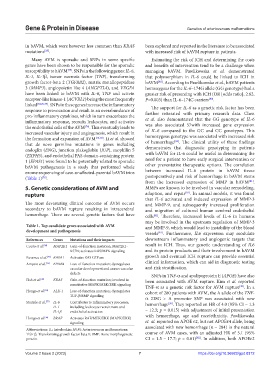
            Table 1. Top candidate genes associated with AVM   and MMP-9, which would lead to instability of the blood
            development and pathogenesis                       vessels . Furthermore,  IL6 expression may modulate
                                                                    [81]
            References  Genes  Mutations and their impacts     downstream  inflammatory  and  angiogenic  targets  that
            Couto et al. [50]  MAP2K1 Gain-of-function mutation, MAP2K1-  result in ICH. Thus, our genetic understanding of  IL6
                               K57N; activates RAS/MPK signaling  and its protein products and their involvement in bAVM
            Revencu et al. [52]  RASA1  Activates RAS GTPase   growth and eventual ICH rupture can provide essential
            Amyere et al. [96]  EPHB4  Loss-of-function mutation; dysregulates   clinical information, which can aid in diagnostic testing
                               vascular development and causes vascular   and risk stratification.
                               defects                           SNPs in TNF-α and apolipoprotein E (APOE) have also
            Fish et al. [69]  KRAS  Gain-of-function mutation; involved in   been associated with AVM rupture. Kim  et al. reported
                               constitutive MAPK/MEK/ERK signaling  TNF-α as a genetic risk factor for AVM rupture . In a
                                                                                                       [30]
            Hongo et al. [54]  ALK-1  Loss-of-function mutation; dysregulates   cohort of 280 patients with AVM, the A allele of the TNF-
                               TGF-β/BMP signaling             α–238G > A promoter SNP was associated with new
            Sturiale et al. [77]  IL-6  Contributes to inflammatory processes,   hemorrhage . They reported an HR of 4.0 (95% CI = 1.3
                                                                         [30]
                        IL-1   including leukocyte recruitment and
                        IL-1β  endothelial activation          – 12.3; p = 0.015) with adjustment of initial presentation
            Hongo et al. [54]  BRAF  Activates RAF/MEK/ERK (MAPK/ERK)   with hemorrhage, age and race/ethnicity. Pawlikowska
                               signaling                       et  al. reported on APOE ε2, but not APOEε4 allele, being
            Abbreviations: IL: Interleukin; AVM: Arteriovenous malformations;   associated with new hemorrhage (n = 284) in the natural
            TGF-β: Transforming growth factor beta 1; BMP: Bone morphogenetic   course of AVM cases, with an adjusted HR of 5.1  (95%
                                                                                    [82]
            protein.                                           CI = 1.5 – 17.7; p = 0.01) . In addition, both APOEε2

            Volume 2 Issue 2 (2023)                         7                        https://doi.org/10.36922/gpd.0312

