


Page 76 - GPD-2-2
P. 76
Gene & Protein in Disease                                            Genetics of arteriovenous malformations


            mediators involved in AVM formation at the genetic level   the signaling and gene expression abnormalities brought
            are effective.                                     on by endothelium Alk1 suppression . Sirolimus uses the
                                                                                            [98]
              Bevacizumab  is  a  humanized  monoclonal  antibody   PI3K-Akt-mTOR cascade to inhibit the overactivation of
            shown in numerous clinical studies as an anti-angiogenic   mTOR in patients with HHT. Sirolimus and nintedanib
            therapy for HHT patients due to its ability to bind and   (tyrosine  kinase  inhibitor)  function  synergistically  to
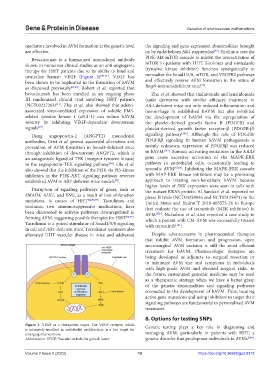
            neutralize human VEGF (Figure 3) [89-91] . VEGF has   normalize the Smad1/5/8, mTOR, and VEGFR2 pathways
            been shown to be implicated in the formation of bAVM   and effectively reverse AVM formation in the retina of
                                                                                      [99]
            as discussed previously [54,92] . Robert  et al. reported that   Bmp9-immunodeficient mice .
            bevacizumab  has  been  enrolled  in  an  ongoing  phase   Zhu et al. showed that thalidomide and lenalidomide
            III randomized clinical trial involving HHT patients   (safer derivative with similar efficacy) treatment in
            (NCT03227263) .  Zhu  et  al.  also  showed  that  adeno-  Alk1-deficient mice not only reduced inflammation and
                         [41]
            associated  virus-mediated  expression  of  soluble  FMS-  hemorrhage  in established  bAVM but  also inhibited
            related tyrosine kinase 1 (sFLT-1) can reduce bAVM   the development of bAVM via the upregulation of
            severity by inhibiting VEGF-dependent downstream   the platelet-derived growth factor B (PDGFB) and
            signals .                                          platelet-derived growth factor receptor-β (PDGFR-β)
                 [93]
              Using   angiopoietin-2  (ANGPT2)   monoclonal    signaling  pathway [102] . Although  the role of PDGFB/
            antibodies, Crist  et al. proved successful alleviation and   PDGFRβ signaling in human bAVM pathogenesis is
            prevention of  AVM formation in  Smad4-deficient mice   mainly unknown, expression of  PDGFRβ was reduced
            through inhibition of downstream ANGPT2, which is   in bAVM [103] . Somatic activating mutations in the KRAS
            an antagonistic ligand of TEK (receptor tyrosine kinase)   gene  cause excessive  activation of  the MAPK-ERK
                                               [94]
            in the angiopoietin-TEK signaling pathway . Ola et al.   pathway in  endothelial cells,  occasionally leading to
            also showed that the inhibition of the PI3K via PI3-kinase   sporadic AVM [67,68] . Inhibiting the MAPK-ERK cascade
            inhibitors in the PI3K-AKT signaling pathway reverses   with MAP-ERK kinase inhibitors may be a promising
            established AVM in Alk1-deficient mice models .    approach to treating non-hereditary bAVM because
                                                  [95]
                                                               higher levels of ERK expression were seen in cells with
              Disruption of signaling pathways of genes, such as   the mutant KRAS protein. Al-Samkari et al. reported on
            SMAD4, ALK1, and ENG, as a result of loss-of-function   phase II trials (NCT04258046 and NCT05125471) in the
            mutations, is causes of HHT [54,96,97] . Tacrolimus and   United States and EudraCT 2019‐003573‐26 in Europe
            sirolimus,  two immunosuppressive medications, have   that evaluate the use of trametinib (MEK inhibitor) in
            been discovered to activate pathways downregulated in   AVM [100] . Nicholson et al. also reported a case study in
            forming AVM, suggesting possible therapies for HHT [98,99] .   which a patient with CM-AVM was successfully treated
            Tacrolimus is a potent stimulator of Smad1/5/8 signaling   with trametinib [101] .
            in cell and Alk1-deficient mice. Tacrolimus treatment also
            alleviated HHT vascular disease in mice and addressed   Despite advancements in pharmaceutical therapies
                                                               that inhibit AVM formation and progression, open
                                                               microsurgical AVM excision is still the most efficient
                                                               treatment  for  bAVM.  Pharmacologic  therapies  are
                                                               being  developed  as  adjuncts  to  surgical  resection  or
                                                               to minimize AVM size and symptoms in individuals
                                                               with high-grade  AVM and elevated surgical risks. In
                                                               the future, customized genomic medicine may be used
                                                               as a therapeutic strategy when we have a better grasp
                                                               of the genetic abnormalities and signaling pathways
                                                               connected to the development of bAVM. Thus, locating
                                                               active gene mutations and using inhibitors to target their
                                                               signaling pathways are fundamental to personalized AVM
                                                               treatment.

                                                               8. Options for testing SNPs
            Figure  3. VEGF as a therapeutic target. The VEGF receptor, which   Genetic testing plays a key role in diagnosing and
            is intimately involved in endothelial proliferation, is a key target for
            emerging interventions.                            managing AVM, particularly in patients with HHT, a
            Abbreviation: VEGF: Vascular endothelial growth factor.  genetic disorder that predisposes individuals to AVMs [104] .


            Volume 2 Issue 2 (2023)                         10                       https://doi.org/10.36922/gpd.0312

