


Page 71 - GPD-2-2
P. 71
Gene & Protein in Disease                                            Genetics of arteriovenous malformations


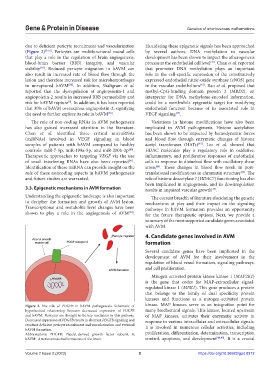
            due to deficient pericyte recruitment and vascularization   Elucidating these epigenetic signals has been approached
            (Figure 2) [9,16] . Pericytes are multifunctional mural cells   by several authors. DNA methylation in vascular
            that  play  a  role  in  the  regulation  of  brain  angiogenesis,   development has been shown to impact the atherogenesis
            blood-brain  barrier  (BBB)  integrity,  and  vascular   process at the endothelial cell level . Chan et al. reported
                                                                                          [42]
            stability . Reduced pericyte migration in bAVM can   that promoter DNA methylation plays an important
                  [38]
            also result in increased rate of blood flow through the   role in the cell-specific expression of the constitutively
            lesion and therefore increased risk for microhemorrhages   expressed endothelial nitric-oxide synthase (eNOS) gene
            in unruptured bAVM . In addition, Shaligram  et  al.   in the vascular endothelium . Rao et al. proposed that
                              [38]
                                                                                      [43]
            reported that the dysregulation of angiopoietin-1 and   methyl-CpG-binding domain protein 2 (MBD2), an
            angiopoietin-2 results in increased BBB permeability and   interpreter for DNA methylome-encoded information,
            risk for bAVM rupture . In addition, it has been reported   could be a worthwhile epigenetic target for modifying
                              [9]
            that 30% of bAVM overexpress angiopoietin-2, signifying   endothelial function because of its associated role in
            the need to further explore its role in bAVM .     VEGF signaling .
                                                                            [44]
                                               [39]
              The role of non-coding RNAs in AVM pathogenesis    Variations in histone modifications have also been
            has also gained increased attention in the literature.   implicated in AVM pathogenesis. Histone acetylation
            Chen  et al. identified three critical microRNAs   has been shown to be impacted by hemodynamic forces
            (miRNAs) involved  in VEGF  signaling  in  blood   and blood flow through enzymatic changes of histone
            samples of patients with bAVM compared to healthy   acetyl transferases (HATs) . Lee  et al. showed that
                                                                                     [45]
            controls: miR-7-5p, miR-199a-5p, and miR-200b-3p [40] .   HDAC molecules play a regulatory role in oxidative,
            Therapeutic approaches to targeting  VEGF via the use   inflammatory, and proliferative responses of endothelial
            of small interfering RNAs have also been reported [41] .   cells in response to disturbed flow with oscillatory shear
            Identification of these miRNA can provide insight on the   stress . These changes in blood flow result in post-
                                                                   [46]
            role of these noncoding aspects in bAVM pathogenesis   translational modifications in chromatin structure . The
                                                                                                       [46]
            and future studies are warranted.                  role of histone deacetylase 7 (HDAC7) functioning has also
                                                               been implicated in angiogenesis, and its downregulation
            3.3. Epigenetic mechanisms in AVM formation        results in impaired vascular growth .
                                                                                           [47]
            Understanding the epigenetic landscape is also important   The current breadth of literature elucidating the genetic
            to decipher the formation and growth of AVM lesion.   mechanisms at play and their impact on the signaling
            Transcriptional and  metabolite level  changes  have  been   pathways in bAVM formation provides an opportunity
            shown to play a role in the angiogenesis of AVM .   for the future therapeutic options. Next, we provide a
                                                        [34]
                                                               summary of the most supported candidate genes associated
                                                               with AVM.

                                                               4. Candidate genes involved in AVM
                                                               formation
                                                               Several candidate genes have been implicated in the
                                                               development  of  AVM  for  their  involvement  in  the
                                                               regulation of blood vessel formation, signaling pathways,
                                                               and cell proliferation.
                                                                 Mitogen activated protein kinase kinase 1 (MAP2K1)
                                                               is the gene that codes for MAP-extracellular signal-
                                                               regulated kinase 1 (MEK1). This gene produces a protein
                                                               that belongs to the family of dual specificity protein
                                                               kinases and functions as a mitogen-activated protein
            Figure  2.  The role of PDGFB in bAVM pathogenesis. Schematic of   kinase. MAP kinases serve as an integration point for
            hypothesized relationship between decreased expression of  PDGFB   many biochemical signals. This kinase, located upstream
            and bAVM. Pericytes are thought to be key mediators in this pathway.   of MAP kinases, activates their enzymatic activity in
            Decreased expression of PDGFB results in aberrant PDGFB signaling and   response to various intracellular and extracellular signals.
            resultant deficient pericyte recruitment and vascularization and eventual   It is involved in numerous cellular activities, including
            bAVM formation.
            Abbreviations: PDGFB: Platelet-derived growth factor subunit  B;   proliferation, differentiation, determination, transcription
            bAVM:  Arteriovenous malformations of the brain.   control, apoptosis, and development [48,49] . It is a crucial


            Volume 2 Issue 2 (2023)                         5                        https://doi.org/10.36922/gpd.0312

