


Page 75 - GPD-2-2
P. 75
Gene & Protein in Disease                                            Genetics of arteriovenous malformations


              The most common cause of CM-AVM is loss-of-      mostly caused by somatic activating R183Q GNAQ
            function mutations in the  RASA1 and  EPHB4 genes   mutations, emerging evidence has implicated somatic
            with a penetrance of 89–95% [41,54] . Similar to HTT,   mutations  in  GNA11  and  GNB2  in  the  pathogenesis
            CM-AVM can also be subdivided based on which gene   of SWS . SWS is associated abnormal vasculature in
                                                                     [85]
            has been mutated. CM-AVM1 is caused by a heterozygous   the brain, skin, and eye resulting in characteristic facial
            loss-of-function  mutation  in  the  RASA1  gene [41,54] .   capillary malformations (port wine stain), glaucoma, and
            RASA1 encodes RASp21, which is a protein that acts   leptomeningeal angiomatosis [83-85] . The leptomeningeal
            as a suppressor of RAS function by boosting the RAS   angiomatosis is characterized by an increased number of
            proteins’ poor intrinsic GTPase activity, which results   capillaries with a reduced number and size of veins in the
            in the inactive GDP-bound form of RAS and permits   pia mater and cerebral cortical surface. While rare, bAVM
            control over cellular proliferation and differentiation .   has been reported with SWS, occurring primarily among
                                                        [93]
            Typically, the inherited mutation is non-sense, frameshift,   infants [83,86-88] . The underlying mechanism of bAVM in
            or a splice-site mutation resulting in a premature stop   SWS remains unknown, but it has been posited that the
            codon [54,92,94] . Conversely, loss-of-function mutation of the   vessel malformation occurring in such cases happens at
            EPHB4 gene results in CM-AVM2 variant [54,61,95] . EPHB4   a different stage than would otherwise occur in classic
            encodes EphB4, a tyrosine kinase receptor that, along with   SWS .
                                                                   [83]
            its ligand, ephrinB2, is a key mediator in angiogenesis [96,97] .
            Contrary to CM-AVM1, 50% of the mutations associated   In the realm of precision medicine, a thorough
            with  EPHB4  are loss-of-function mutations associated   foundation of genetic basis for disease can prove especially
            with null alleles, while the remaining 50% are missense   useful for  more innovative treatment  approaches.  Next,
            mutations [54,95,98] . These missense mutations typically   we discuss the ongoing research on and the emerging
            affect the extracellular domain or the intracellular protein   treatment options for AVM both in its sporadic form and
            tyrosine kinase domain [54,95] . Clinically, CM-AVM1 and   its associated genetic conditions as well as the impact
            CM-AVM2 have similar presentations. However, fast-  of varying genotypes and its related targeted therapies
            flow vascular malformations are typically associated less   (Table  2).
            with CM-AVM2 compared  to  CM-AVM1. Of patients    7. New advances and emerging treatments
            with CM-AVM2, an estimated 18% present with fast-flow
            vascular malformations, of which only 3% occur in the   The management of AVM typically calls for a
            brain [54,95] .                                    multidisciplinary approach. New and emerging
                                                               treatments for AVM have been developed due to recent
            6.3. Parkes Weber syndrome and Sturge Weber        developments in the field of study. This section will
            syndrome                                           discuss some of the most exciting recent discoveries
            Parkes  Weber  syndrome  (PWS)  is  characterized  by  a   and cutting-edge AVM therapies. Due to the risk and
            triad  of  limb  hypertrophy,  port-wine  stain,  and  high-  controversies associated with surgical, endovascular, and
            flow AVM [99,100] . PWS is a congenital vascular disorder   radiotherapeutic procedures, there has been an increase
            associated with mutations in RASA1 [100,101] . The prevalence   in the demand for pharmacological treatment modalities.
            of this condition is not well described, and it does not   Pharmacological therapies targeting various critical
            appear  to  have  a  predilection  for  race  or  gender.  The
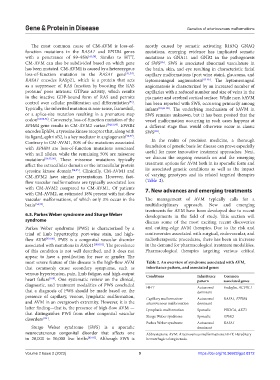
            most severe feature of this disease is the high-flow AVM   Table 2. An overview of syndrome associated with AVM,
            that commonly cause secondary symptoms, such as    inheritance pattern, and associated genes
            venous hypertension, pain, limb fatigue, and high-output   Conditions    Inheritance   Common
            heart failure [100] . One systematic review on the clinical,             pattern    associated genes
            diagnostic, and treatment modalities of PWS concluded   HHT              Autosomal   Endoglin, ACVRL1
            that  a  diagnosis  of  PWS  should  be  made  based  on the             dominant
            presence  of  capillary,  venous,  lymphatic  malformation,   Capillary malformation-  Autosomal   RASA1, EPHB4
            and AVM in an overgrowth extremity. However, it is the   arteriovenous malformation  dominant
            latter finding—that is, the presence of high-flow AVM —   Lymphatic malformation   Sporadic  PIK3CA, AKT1
            that distinguishes PWS from other congenital vascular
            disorders [101] .                                  Sturge Weber syndrome  Sporadic  GNAQ
                                                               Parkes Weber syndrome   Autosomal   RASA1
              Sturge Weber syndrome (SWS) is a sporadic                              dominant
            neurocutaneous congenital disorder that affects one   Abbreviations: AVM: Arteriovenous malformations; HHT: Hereditary
            in 20,000 to 50,000 live births [83-85] . Although SWS is   hemorrhagic telangiectasia.


            Volume 2 Issue 2 (2023)                         9                        https://doi.org/10.36922/gpd.0312

