


Page 98 - GTM-2-3
P. 98
Global Translational Medicine                                        Autoimmune diseases after vaccination


            Table 1. Autoimmune adverse events and doses by COVID‑19 vaccine. VAERS data include adverse event reports from 1990 to
            May 19, 2023
            Adverse event               COVID‑19 Ad26.Cov2.S       COVID‑19 elasomeran       COVID‑19 tozinameran
            Administered doses             19,007,537 (3.1%)        232,147,784 (37.6%)       366,979,906 (59.4%)
            Alopecia                         220 (5.5%)               1,174 (29.6%)             2,570 (64.8%)
            Arthritis                        204 (4.9%)               1,277 (30.6%)             2,692 (64.5%)
            Bell’s palsy                     343 (4.7%)               1,981 (27.1%)             4,980 (68.2%)
            Guillain-Barré syndrome          554 (16.2%)               657 (19.3%)              2,200 (64.5%)
            Immune thrombocytopenia          108 (6.6%)                383 (23.3%)              1,155 (70.2%)
            Rheumatoid arthritis             109 (3.2%)                824 (24.4%)              2,443 (72.4%)
            Note: The percentages in parentheses represent the proportion of this adverse event by vaccine.


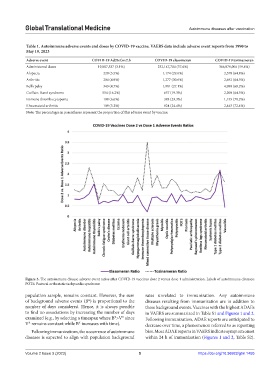
            Figure 3. The autoimmune disease adverse event ratios after COVID-19 vaccines dose 2 versus dose 1 administration. Labels of autoimmune diseases:
            POTS: Postural orthostatic tachycardia syndrome.

            population sample, remains constant. However, the sum   rates  unrelated  to  immunization.  Any  autoimmune
            of background adverse events (B ) is proportional to the   diseases resulting from immunization are in addition to
                                       X
            number of days considered. Hence, it is always possible   these background events. Vaccines with the highest ADAEs
            to find no associations by increasing the number of days   in VAERS are summarized in Table S1 and Figures 1 and 2.
            examined (e.g., by selecting a timespan where B >V  since   Following immunization, ADAE reports are anticipated to
                                                  X
                                                     X
            V  remains constant while B  increases with time).  decrease over time, a phenomenon referred to as reporting
                                   X
             X
              Following immunizations, the occurrence of autoimmune   bias. Most ADAE reports in VAERS indicate symptom onset
            diseases is expected to align with population background   within 24 h of immunization (Figures 1 and 2, Table S2).
            Volume 2 Issue 3 (2023)                         5                        https://doi.org/10.36922/gtm.1455

